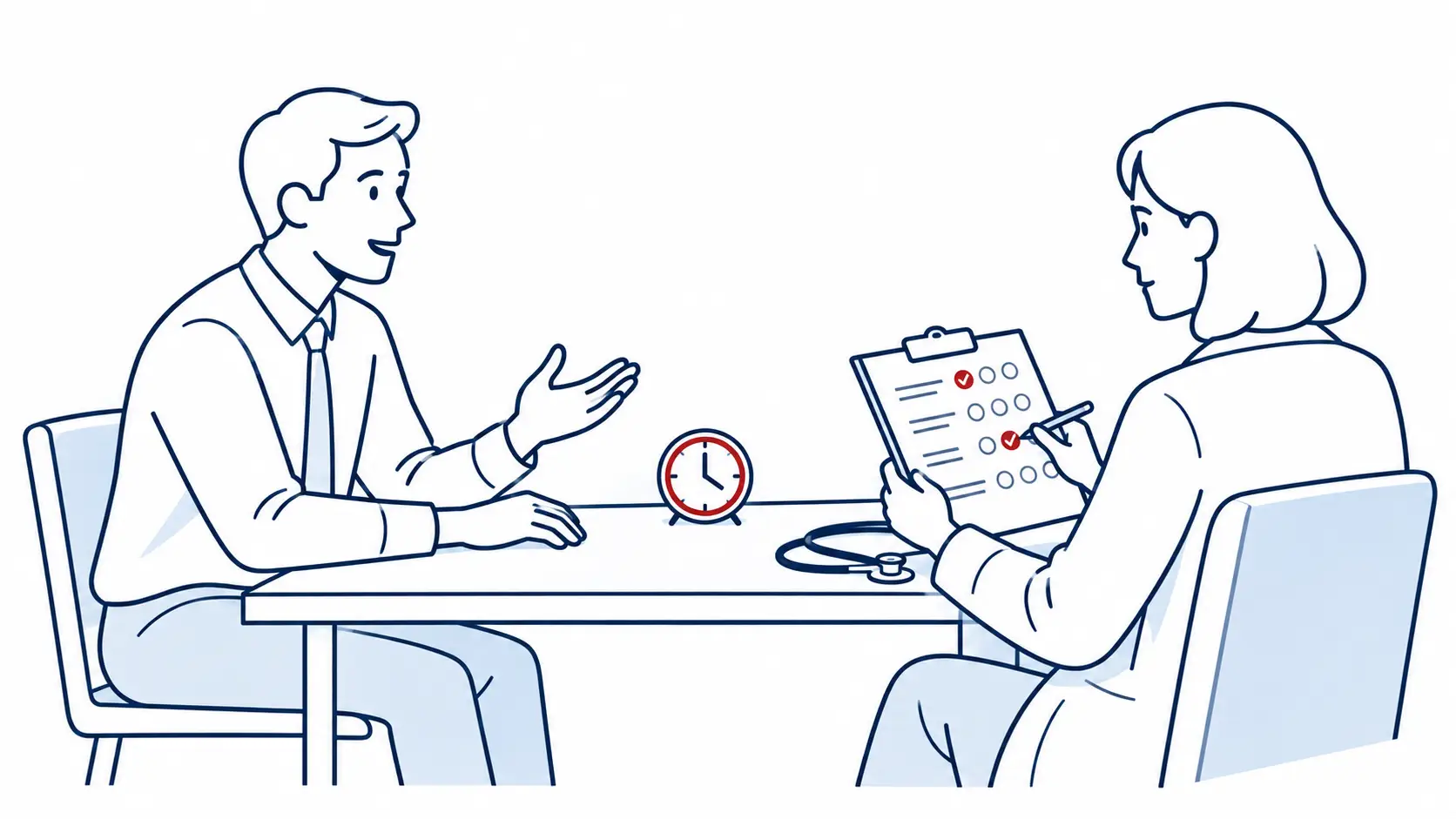
TL;DR: A polished, memorized answer isn’t the safe move it feels like. In AAMC interview guidance, a medical school admissions officer describes seeing applicants flagged as “too rehearsed” or “too scripted,” and the broader guidance is straightforward: prepare, but don’t memorize your answers to the point that you stop responding naturally.
The problem isn’t that your answer sounds good. It’s that a scripted answer can make you answer the question you prepared instead of the question you were actually asked. At that point, the polish stops helping and starts looking like a communication problem.
The fix isn’t winging it. It’s knowing your experiences well enough that you can adapt them in real time.
Why does a “good” answer sometimes score worse?
Because in an MMI or any structured medical school interview, you’re not just being evaluated on what you say.
You’re also being evaluated on whether you can communicate clearly, think through what is actually in front of you, and respond to the person asking the question instead of to the question you rehearsed at home.
Sunny Nakae, writing for the AAMC while serving as Assistant Dean for Admissions at Loyola University Chicago Stritch School of Medicine, described seeing interview reports in which applicants were flagged as “too rehearsed” or “too scripted.” She also explained the underlying problem: applicants who memorize responses can end up answering the question they prepared for instead of the question they were actually asked.
That’s the trap.
You walk in with a strong, polished answer to “Why medicine?” Then the interviewer asks something adjacent to it, but not quite the same thing.
If your only move is to deliver the script anyway, you’ve just demonstrated the opposite of what the interview is supposed to reveal.
I saw versions of this from the evaluator side when I was interviewing and scoring applicants in the MMI format. The goal wasn’t to reward whoever sounded the most polished. I needed to see how you were thinking through the scenario in front of you. If you were clearly trying to force a prepared answer onto a question that didn’t quite fit it, the polish wasn’t helping you anymore.
If you want a deeper breakdown of what interviewers are actually evaluating across MMI stations, I also put together a guide on how MMI scoring works and what interviewers are looking for.
What does “too rehearsed” actually signal to an interviewer?
Not that you’re a bad candidate.
It signals a communication problem, and communication is exactly one of the things the interview is designed to assess.
The AAMC describes the MMI as a format used to evaluate qualities such as oral communication, social and nonverbal skills, and teamwork. These are things your GPA, MCAT score, and written application can’t fully show.
When you recite instead of respond, the interviewer isn’t really seeing your reasoning in real time.
They’re hearing the result of reasoning you already did somewhere else, days or weeks earlier.
That’s why rehearsed answers can sound impressive while still being weaker than a less polished answer that actually engages with the question.
What’s the difference between preparing and rehearsing?
Preparing means you know yourself and your experiences well.
You know what’s on your application. You understand why you want to become a physician. You’ve reflected on your biggest failures, conflicts, challenges, accomplishments, and turning points. You know what those experiences taught you.
Rehearsing means you’ve decided exactly how those things are supposed to sound out loud, and you’re committed to that wording regardless of what the interviewer actually asks.
Here’s the easiest test:
If an interviewer asked you the same general question in three slightly different ways, would your answer change to fit each one?
Or would you find yourself giving essentially the same paragraph every time?
If it’s the same paragraph every time, that’s rehearsal.
Know the substance. Don’t memorize the wording.
What should you actually do to prepare, then?
Build a story bank, not a script.
The AAMC’s own interview preparation guidance recommends identifying experiences from your background that demonstrate your qualities and keeping a brief list of examples you can adapt to different interview questions.
That’s a much better way to prepare.
Go through your application and pull out five or six real moments:
a failure
a moment of teamwork
a conflict
a time you changed your mind
a challenge you had to work through
an experience that shaped your interest in medicine
Know each one well enough that you could explain it in thirty seconds, ninety seconds, or three minutes depending on what you’re asked.
Practice choosing the right story for the question.
Don’t practice forcing the same story into every question.
This is also where a mock interview earns its keep. The purpose isn’t to make your answers more memorized. It’s to practice hearing the actual question, deciding what experience fits, and building a clear answer in real time.
That’s also how I approach practice inside Inside the Medical School Interview. You’re not trying to memorize the “right” response. You’re practicing enough different questions and scenarios that answering flexibly starts to feel normal.
Does this mean I shouldn’t practice out loud?
No.
You should practice out loud a lot.
The goal isn’t spontaneity for its own sake. It’s the difference between knowing your material so well that you can adapt it and knowing a script so well that you can’t.
Out-loud practice helps you notice where you ramble, where your explanation gets confusing, and where a story takes three minutes when it should take one.
It should make you more flexible.
Not more robotic.
Why this matters even more in the MMI
The MMI makes this problem especially obvious because you’re rotating through multiple interviewers and multiple scenarios.
You may get an ethical dilemma at one station, a teamwork problem at another, a behavioral question somewhere else, and a scenario that doesn’t resemble anything you practiced.
That variability is part of the point.
If your preparation method depends on predicting the exact question, you’re preparing for the wrong thing.
A much better goal is to become comfortable doing three things quickly:
Understand what the question is actually asking.
Organize your thoughts.
Communicate them clearly without reaching for a memorized script.
That skill transfers from station to station even when the content changes.
FAQ
Is it ever okay to have a fully memorized answer for something like “Why medicine?”
Know your reasoning extremely well, but resist locking the exact wording. Interviewers can ask “Why medicine?” in dozens of slightly different ways, and a fixed script only fits one of them.
Will an interviewer really notice if I’ve memorized an answer?
Yes, they can. AAMC interview guidance specifically discusses applicants being described in interview reports as “too rehearsed” or “too scripted.” The more interviews someone conducts, the easier it becomes to recognize when an answer sounds delivered rather than considered.
Does this apply to traditional one-on-one interviews too, or just the MMI?
The principle applies to both. The MMI makes the problem easier to see because you’re rotating through multiple interviewers and scenarios, but traditional interviewers still need to see whether you’re genuinely engaging with their questions.
What if I freeze without a script to fall back on?
That’s exactly what a story bank is designed to solve. You’re not improvising from nothing. You’re pulling from real experiences you’ve already thought through and shaping them to fit the question in front of you.
How is this different from generic interview prep?
A lot of interview prep focuses on practicing answers until they sound polished. The more useful distinction is between practicing and memorizing. You should absolutely practice, but the goal is to become more adaptable, not more scripted.
Don’t Memorize Better Answers. Get Better at Interviewing.
You can read every list of common medical school interview questions online and still walk into your interview feeling unprepared.
The goal isn’t to predict every question.
It’s to become comfortable enough with the process that you can hear the question, think through it, and give a strong answer without reaching for a script.
That’s why I created Inside the Medical School Interview.
I built it using what I learned from being on the other side of the MMI, interviewing and scoring medical school applicants, and it gives you the practice material to actually apply what you’ve learned:
Get Inside the Medical School Interview

Wil Caruso, MD is the founder of Pre-Med Community and a pre-med admissions consultant who knows the journey firsthand. After navigating the pre-med and medical school application process himself, he went on to serve as a medical school MMI interviewer and residency admissions committee member. He created Pre-Med Community to give aspiring physicians the honest, practical guidance he wishes every pre-med had access to.