Medical School Interviews
MMI Interview: Complete Guide to Multiple Mini Interviews
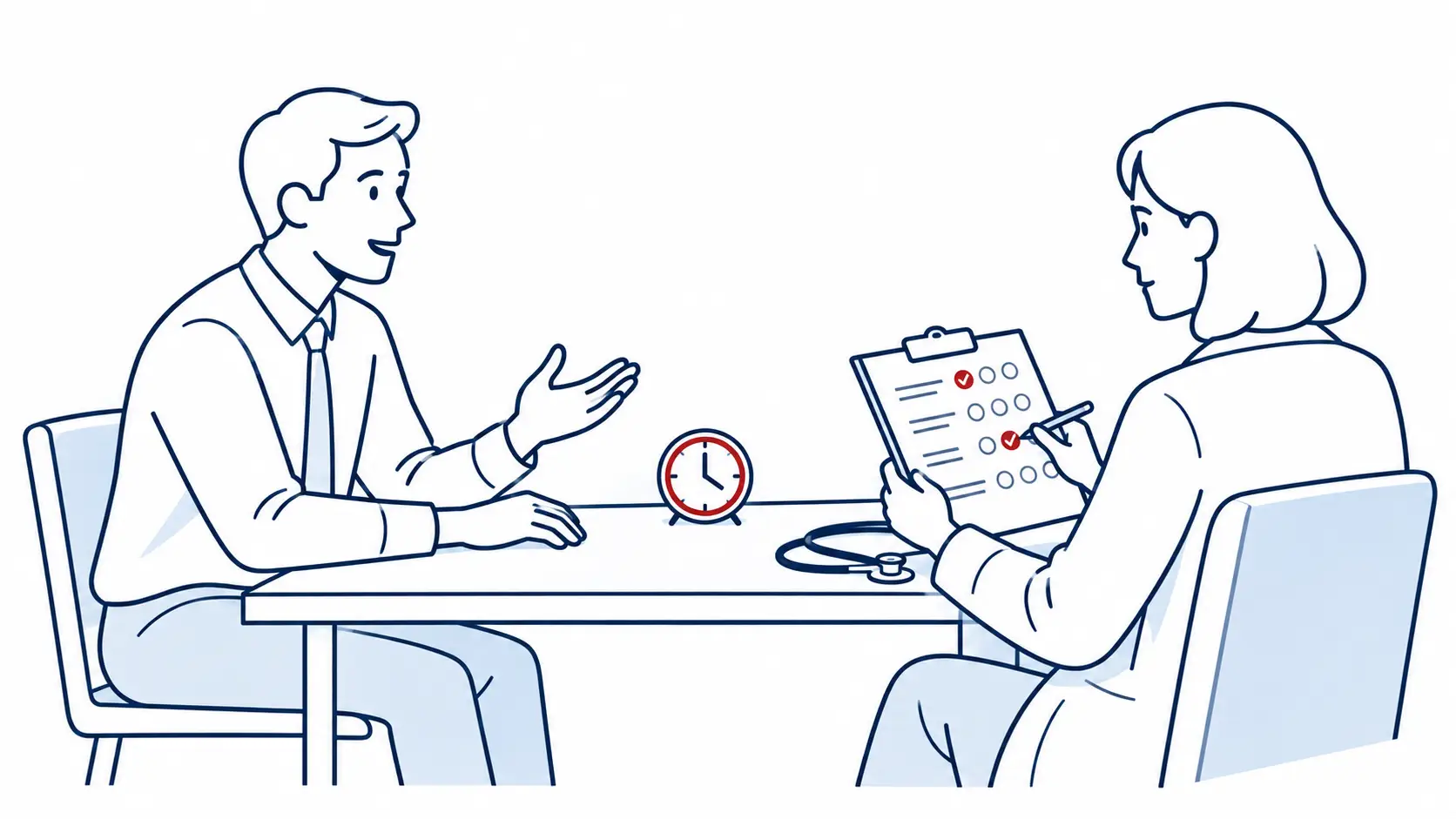
The MMI can feel intimidating because the prompt changes, the interviewer changes, and the clock keeps moving. You do not need a perfect script for every station. You need a way to read the question, choose a direction, and let someone follow your thinking.

A multiple mini interview is a series of short stations, each with a different prompt or task. Formats vary by school. Prepare by practicing how to answer the actual question, explain your reasoning, give one relevant example when needed, and finish with a clear takeaway. For situational prompts, show what you would do first and why, not just what value you believe in.
Here is something I noticed when I interviewed and scored MMI applicants: a good thought could disappear inside a messy answer. An applicant would start with a reasonable point, leave it to chase a second idea, add a third example, and run out of time before explaining what they would actually do.
From the other side of the table, the stronger answers were easier to follow. I could hear the applicant's decision, the reason behind it, and whether they could respond to a follow-up. That does not mean there is one magic phrase that earns a score. It means the interviewer should not have to excavate your point.
This guide is about making your thinking visible under a clock.
What is a multiple mini interview?
A multiple mini interview, or MMI, is a circuit of short interview stations. Each station gives you a new question, scenario, conversation, or task. You may meet different interviewers at different stations. The AAMC describes a typical MMI as six to ten stations, but your school's invitation is the authority for its actual format.
A traditional interview often lets one person get to know you over a longer conversation. The MMI samples how you communicate and reason across several shorter interactions. Some stations may feel like ordinary interview questions. Others ask you to navigate an ethical tension, talk with an actor, work with someone, or interpret a situation. The AAMC notes that schools can also include writing or rest stations.
You are not expected to arrive with clinical knowledge you have not been taught. The AAMC frames the MMI around interpersonal and critical-thinking skills, not a test of specialized medical facts. That is a useful distinction when you prepare: spend less time memorizing policy slogans and more time practicing how to think aloud.
What happens at an MMI station?
- You receive the prompt. It may be posted outside a room or presented on a virtual platform.
- You get a brief preparation window. Read for the actual task and any constraints. Do not build a five-part speech in your head.
- You enter and respond. Depending on the station, you may discuss the scenario, interact with an actor, or complete a task.
- You may get follow-up questions. Treat them as part of the conversation, not proof that your first answer was wrong.
- You move on. The next station is a new opportunity, even if the last one felt rough.
The AAMC gives an example of roughly two minutes to prepare and five to eight minutes to converse, but do not assume those times apply to your interview. Check the invitation, school website, and the AAMC's school-specific interview policies resources. Confirm whether the interview is in person or virtual, whether you can take notes, and what equipment or materials are allowed.
Ask: What am I being asked to decide or explain? Who is affected? What fact is missing? What is my first responsible step? If you can answer those four questions, you have a direction.
Common MMI station types and how to approach them
Ethical or situational scenarios
These ask what you would do when values or responsibilities pull in different directions. Name the tension, consider the people involved, and give a practical first step. If safety, privacy, or honesty is at stake, say so. Avoid jumping straight to punishment or pretending you know a policy you have not seen.
Role-play and communication
You may speak with someone who is upset, confused, or resistant. Your job is to interact, not perform a speech about empathy. Open with a question, listen to the response, acknowledge what you heard, and then work toward a next step.
Teamwork or collaborative tasks
Show that you can make space for another person while moving the work forward. Contributing one useful idea, checking understanding, and adapting when a teammate spots a problem are more persuasive than dominating the task.
Behavioral and personal questions
These ask about a real experience, such as feedback, conflict, or failure. Choose one example. Explain your action and what changed afterward. A lesson like “teamwork is important” is too broad; a specific behavior you changed is much stronger.
Policy, current-event, or interpretation prompts
Some schools ask you to weigh an issue or reason from information in the room. Do not manufacture expertise. Separate what you know from what you would need to learn, and explain the tradeoff. The AAMC notes that schools tailor station topics to their goals, so review the school's own materials rather than guessing its exact questions.
What made MMI answers easier to evaluate?
When I scored applicants, I was not waiting for a polished TED Talk. I wanted to know what they thought and how they got there. A clear first sentence helped. So did a concrete next action. The answer became weaker when it drifted into a catalog of admirable values with no decision attached.
Address the question you were given, not the adjacent question you practiced yesterday.
Explain the consideration behind your choice. Show the tradeoff when there is one.
Say what you would do first, and who you would involve if needed.
Land the point. Do not spend the final minute opening a new branch.
Clarity is not the same as certainty. “I would first make sure I understand what happened” can be a strong opening when facts are missing. You can be decisive about your process without pretending the scenario is simpler than it is.
A practical structure for almost any MMI answer
Before you speak, finish this sentence in your head: “By the end of this answer, I want them to understand _____.” That is the destination. Then use a structure that fits the station rather than forcing every prompt into the same template.
For a situational station: tension, information, action, reason
- State the tension. What needs to be balanced?
- Identify a missing fact. What would change your response?
- Give a first action. What can you responsibly do now?
- Explain why and what comes next. Address a foreseeable complication or follow-up.
Do not spend two minutes listing every stakeholder you can imagine. Pick the people and facts that actually affect your next step.
For a personal story: point, one example, change
- Say the point early. “I learned to ask for feedback before a problem grows.”
- Use one scene that proves it. Give the necessary context, what you did, and the result.
- Show the change. What do you now do differently?
A good story is not a resume recap. It is evidence for one claim. If a detail does not help prove that claim, you can usually cut it.
Want a practice sheet beside you?
PMC's free Medical School Interview Guide is a useful place to organize prompts, examples, and your own answer structure before you start timed practice.
Get the free interview guideThree MMI examples, with the thinking shown
Scenario / honesty and teamwork
A teammate asks you to record volunteer hours they did not work
Prompt: You help coordinate a student volunteer program. A teammate says they had a family emergency and asks you to sign off on a shift they missed. What do you do?
A stronger opening: “I would not record hours they did not work, but I would speak with them privately before assuming why they asked. I would explain that the record needs to be accurate, ask whether they need help communicating the missed shift, and look for an honest way to make up the time if the program allows it.”
Why it works: The answer makes a decision immediately, preserves honesty, and still treats the teammate as a person. It does not invent a disciplinary rule or turn the response into a lecture. If the teammate insists or the record has already been submitted, the applicant can explain that they would correct it through the program's appropriate channel.
Role-play / listening under pressure
A volunteer partner says you took credit for their work
Prompt: Your partner is upset that you described a project as “my initiative” during a meeting. Begin the conversation.
A stronger opening: “I can see why that sounded like I was taking credit for work we did together. I am sorry I phrased it that way. Can you tell me what part of the meeting felt most unfair? I want to correct the record with the team, and I want to make sure I do it in a way that reflects your contribution.”
Why it works: The applicant does not debate the person's feelings or rush to defend intent. They acknowledge the impact, ask a real question, and name a repair. In a live role-play, the next move is to listen to the actor's response, not recite the rest of a prepared script.
Behavioral / difficult feedback
Tell me about feedback you did not want to hear
A stronger answer: “During a clinic volunteer shift, my supervisor told me I was moving people through check-in too quickly and missing questions they were trying to ask. I was embarrassed because I thought speed was helping. I asked her what she had noticed, then started pausing after each explanation and asking whether the person needed anything clarified. My check-ins took a little longer, but people stopped needing to repeat the same question at the desk. I learned that efficiency is not useful if the person in front of me leaves confused.”
Why it works: There is a specific piece of feedback, a concrete adjustment, and an observable change. The final sentence has a destination. It does not hide behind “I learned communication is important.”
MMI practice questions by station type
Use these as practice prompts, not as a predicted question bank. For each one, spend a short preparation window writing your destination sentence. Then answer aloud, on a timer, and listen back for the point where you begin to wander.
Ethical and situational
- A friend asks you to confirm that they attended an event they missed. What do you do?
- You hear a student sharing identifiable details from a clinical experience in a public place. How would you respond?
- A teammate repeatedly misses deadlines, but you learn they are caring for a family member. How do you handle the project?
- You disagree with a policy intended to make a service more efficient but worry it disadvantages some people. How would you raise your concern?
Communication and role-play
- Explain to an upset teammate why you changed part of a shared presentation without telling them.
- A new volunteer is frustrated because instructions seem contradictory. Start the conversation.
- A peer says your feedback in a group meeting embarrassed them. Respond.
Personal and reflective
- Describe a time you changed your mind after hearing someone else's perspective.
- Tell me about feedback that changed your behavior.
- Describe a time you had to admit you were wrong.
- Tell me about a commitment you could not fulfill and what you did next.
Teamwork and reasoning
- Your group has five minutes to choose between two imperfect plans. How would you help the team decide?
- You are given a small amount of new information halfway through a task. How do you revisit your initial conclusion?
- What would you do if one team member speaks over everyone else while another has not spoken at all?
Notice what is missing from this list: “the correct answer.” That is intentional. Your practice should make your reasoning clearer, not make you sound identical to everyone else who found the same answer online.
How to prepare for an MMI in one week
You do not need to spend seven days collecting hundreds of prompts. You need repetitions that reveal what happens to your answers under time pressure.
- Day 1: Confirm the format. Read your school's invitation and official interview page. Note the platform or location, timing, station types if disclosed, and any rules on note-taking.
- Day 2: Build your story bank. Pick five real experiences: feedback, conflict, teamwork, service, and a mistake. Write one sentence about what changed in each.
- Days 3 and 4: Practice varied stations. Use a timer. Do two situational prompts, one role-play, and one personal question each day. Do not reuse the same opening for all four.
- Day 5: Get outside feedback. Ask a listener whether they could state your point after the first 20 seconds, and whether your next action was concrete. “Sounded good” is not enough feedback.
- Day 6: Repair your recurring problem. If you ramble, practice one-sentence openings. If you leap to conclusions, practice identifying missing facts. If you are too abstract, practice naming your first action.
- Day 7: Run a short circuit and stop. Try three to five fresh stations back-to-back, with brief transitions. Then review logistics and rest.
After each answer, ask: Did I answer the actual prompt? Did I say what I would do? Did I explain why? Did I leave room for uncertainty without hiding behind it? Could the listener repeat my takeaway?
If you want a fuller sequence of lessons and examples, PMC's Inside the Medical School Interview course is the next step after this guide. Use it to build an approach, then test that approach aloud. Reading about MMIs and doing an MMI are different skills.
MMI mistakes that make a good applicant hard to follow
- Answering before identifying the task. A prompt that asks “how would you begin the conversation?” does not require a speech about every possible outcome.
- Listing values instead of acting. “I value honesty and empathy” is a start. “I would correct the record and speak privately with my teammate” is an answer.
- Adding examples after the point is already clear. One example that proves the claim usually beats three that dilute it.
- Performing empathy. In a role-play, ask and listen. Do not keep saying “I understand” while ignoring what the person just told you.
- Claiming certainty you do not have. Explain what you would verify and who you would consult. Do not invent a school's policy or a clinical rule.
- Carrying a bad station into the next one. You cannot revise the previous station while answering the current one.
The simplest correction is also the least glamorous: before the timer starts, choose the point you are going to make. Then let every part of your answer serve it.
MMI interview-day checklist
- Recheck the school's instructions, schedule, time zone, location or login link, and identification requirements.
- For a virtual MMI, test your camera, microphone, connection, lighting, and quiet space in advance. The AAMC gives similar virtual-interview preparation advice.
- During the reading period, mark the task, key tension, and first action. Do not try to memorize a paragraph.
- If you need a moment, pause. A brief pause is easier to follow than a minute of filler.
- Answer the question early, then explain. If the interviewer challenges your view, engage with the new information.
- After each station, reset. One awkward answer is not the entire circuit.
If your interview is close and you need another person to pressure-test your answers, a PMC mock interview can show you where your reasoning becomes hard to follow. The most useful feedback is specific: what landed, where you lost the listener, and what to change on the next repetition.
Frequently asked questions about MMIs
How long is an MMI interview?
It depends on the school. The AAMC describes a common format with six to ten stations and short preparation and conversation windows, but station count and timing vary. Follow the invitation you receive, not someone else's schedule.
Is there one right answer to an MMI ethics question?
Usually, the useful work is to explain your decision, the people affected, the facts you would check, and the action you would take. Some actions may clearly be inappropriate, such as falsifying a record, but a good answer is more than naming a principle.
Can I pause before answering?
Yes. A short pause to organize your response is usually better than filling the silence with a directionless opening. Keep the clock in mind, then state your point.
What if I do badly at one station?
Move on. A multi-station format gives you another interaction after the one that felt difficult. You may also have judged your performance more harshly than the interviewer did.
How do I practice an MMI by myself?
Read an unfamiliar prompt, give yourself the preparation time specified by your school if known, answer aloud on a timer, and record yourself. On replay, check whether your first sentence has a direction and whether you named a concrete action. Add another person for role-play and feedback when possible.
The point to take into your next station
You do not need to be the applicant who has an elegant speech ready for every prompt. You need to be the applicant who can hear the question, think carefully, and say where the answer is going.
That is what I would practice. Choose the destination. Give the listener one clear route there. Then, when the station ends, let it end and start fresh.
Keep practicing with a plan
Start with the free guide for structure. Use the course if you want a deeper system, or book a mock interview when you need live feedback before interview day.
Free interview guide Interview course Mock interview
Wil Caruso, MD is the founder of Pre-Med Community and a pre-med admissions consultant who knows the journey firsthand. After navigating the pre-med and medical school application process himself, he went on to serve as a medical school MMI interviewer and residency admissions committee member. He created Pre-Med Community to give aspiring physicians the honest, practical guidance he wishes every pre-med had access to.