
Pre-Med Extracurriculars: What Matters for Medical School and How to Build Your Experiences
The strongest pre-med extracurricular profile is not the one with the longest activity list. It is the one that shows how you explored medicine, served others, developed useful skills, pursued genuine interests, and grew over time.
Already know what type of experience you need? Jump directly to PMC's clinical, research, volunteer, shadowing, leadership, and other extracurricular guidance.
Browse experience guides ↓Pre-med students often hear that they need clinical hours, research, volunteering, shadowing, leadership, clubs, and a long list of other activities. That can turn extracurricular planning into a checklist.
Medical-school applications are broader than that. AMCAS recognizes many types of experiences, including clinical and nonclinical service, paid employment, research, shadowing, leadership, teaching, athletics, hobbies, artistic endeavors, community health advocacy, publications, presentations, and other activities.
The goal is not to force every category into your application. The goal is to build meaningful experiences that help you understand medicine, contribute outside yourself, develop useful competencies, and show who you are beyond grades and test scores.
Is there a required extracurricular checklist?
No universal checklist applies to every school. Applicants can demonstrate preparation and competencies through many combinations of experiences.
Do you need research?
Not universally. Research matters more for some schools and becomes central for MD/PhD applicants.
Do hobbies count?
Yes. AMCAS includes hobbies and artistic endeavors among its experience types. Not everything meaningful has to be medically related.
What matters more than the activity name?
What you did, how long you stayed involved, how responsibility grew, what you learned, and how the experience fits your broader preparation.
Keep Every Experience Organized Before Application Season
Track clinical experience, research, volunteering, shadowing, employment, leadership, hours, supervisors, responsibilities, and reflections before you are trying to reconstruct everything for AMCAS.
Get the Free Pre-Med Experience Tracker →What medical schools are actually looking for
Extracurricular activities matter because they are evidence. They show what you have actually done outside the classroom and which environments have helped you develop.
The AAMC's current Premed Competencies include professional, thinking and reasoning, and science competencies such as service orientation, empathy and compassion, reliability, teamwork and collaboration, self-awareness, scientific inquiry, critical thinking, and communication.
No one activity demonstrates everything. Different experiences can reveal different parts of you.
| Experience | What it can help demonstrate | What not to reduce it to |
|---|---|---|
| Clinical experience | Patients, health-care delivery, illness, teams, realities of medicine | A magic hour number |
| Community service | Service orientation, reliability, empathy, community engagement | A box to check |
| Research | Scientific inquiry, critical thinking, uncertainty, evidence | A publication race |
| Shadowing | Physician roles, specialties, workflow and professional life | A substitute for patient-facing experience |
| Leadership | Responsibility, coordination, initiative and teamwork | A title without substance |
| Employment | Reliability, professionalism, teamwork and real-world responsibility | Something to hide because it is not “premed” |
| Hobbies / arts / athletics | Identity, discipline, creativity, teamwork and genuine interests | Wasted space because it is nonmedical |
Instead of asking “Which activity looks best?” ask “What am I missing from my actual preparation for medicine, and what experience would help me develop it?”
Explore pre-med experiences and opportunities
Use the guide that matches the problem you are trying to solve rather than trying to do everything at once.

Clinical Experience
What counts, how many hours matter, paid vs. volunteer roles, and how to find patient-facing opportunities.
Explore Clinical Opportunities →
Research Opportunities
Find labs and programs, approach professors, evaluate research, and understand publications and summer opportunities.
Explore Research Opportunities →
Volunteer Opportunities
Clinical vs. nonclinical service, meaningful involvement, national finders, and how to find opportunities near you.
Explore Volunteer Opportunities →
Physician Shadowing
How to find physicians, how much variety is useful, and how to learn from observation without treating shadowing as clinical experience.
Explore Physician Shadowing →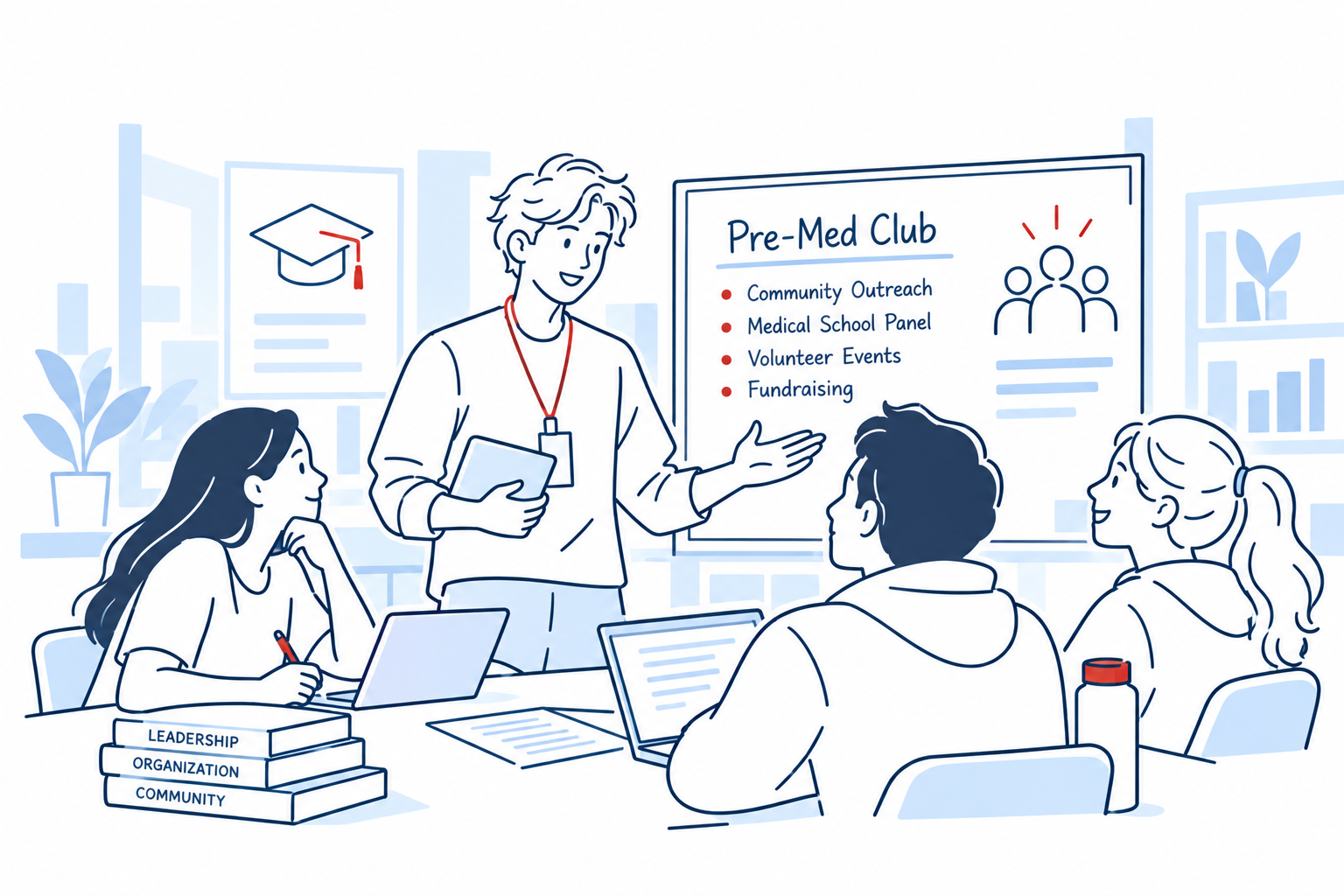
Leadership & Campus Involvement
Leadership without title-chasing, meaningful club involvement, responsibility, teamwork, and initiative.
Explore Leadership Opportunities →
Post-Bac & Academic Enhancement
Post-bac programs are academic pathways, not extracurriculars. If you need prerequisites, GPA enhancement, or a special master’s program, compare your options here.
Explore Post-Bac Programs →A note about post-bacs: They are academic-enhancement options rather than extracurricular activities. They are linked here because students comparing their next steps may need academic strengthening instead of another activity.
Clinical experience
Clinical experience helps answer whether you have spent enough meaningful time around patients and health care to make an informed decision about becoming a physician.
It can be paid or volunteer. What matters is what you actually do. Scribes, EMTs, CNAs, medical assistants, patient-care technicians, hospice volunteers, clinic volunteers, and similar roles can provide very different exposure depending on their duties.
Volunteering and community service
Service does not have to be medical. Food access, tutoring, shelters, refugee assistance, disability services, senior support, mentoring, crisis support, disaster response, and other work can show how you engage with people and communities outside medicine.
Choose service that meets a real need and that you can sustain.
Research
Research teaches you how knowledge is created rather than simply memorized. It can develop scientific inquiry, critical thinking, quantitative reasoning, persistence, communication, and comfort with uncertainty.
It is not universally required and does not have to mean wet-lab biology. Clinical, public-health, social-science, computational, translational, and humanities research can all be legitimate.
Track the Experiences That Are Becoming Your Application
Keep dates, hours, supervisors, responsibilities, research outputs, leadership, and meaningful reflections organized as you go. Details that feel obvious now are surprisingly hard to reconstruct later.
Get the Free Pre-Med Experience Tracker →Physician shadowing
Shadowing is observation. Its value is helping you understand what physicians actually do: how they spend their day, communicate with patients, work within teams, make decisions, document care, and navigate different specialties.
Shadowing should not replace clinical experience. You also do not need to collect every specialty. Some breadth is useful; specialty collection is not the goal.
Leadership
Leadership is not synonymous with president, vice president, or founder. It means taking meaningful responsibility for people, projects, decisions, or outcomes.
- Train newer volunteers or employees
- Manage a team or project
- Coordinate research
- Lead a campus organization
- Organize service
- Coach or mentor
- Improve a process
- Run a business or project
Responsibility that others actually rely on is stronger than an impressive-sounding title with little substance.
Paid employment absolutely counts
AMCAS recognizes both medical/clinical and nonmedical paid employment. Jobs can demonstrate reliability, professionalism, teamwork, communication, time management, leadership, and the ability to balance competing responsibilities.
If you worked significant hours to support yourself or your family, do not hide that because someone else had more time for unpaid extracurriculars.
Teaching, tutoring, and mentorship
Teaching forces you to communicate clearly and adapt when someone does not understand. Examples include tutoring, teaching assistant roles, coaching, mentoring, science outreach, language instruction, and training newer employees or volunteers.
Hobbies, arts, athletics, and interests outside medicine
Your application does not need to suggest you stopped having a personality when you became pre-med. AMCAS includes hobbies, artistic endeavors, and athletics among its experience types.
Music, art, photography, writing, athletics, gaming or esports, hiking, dance, entrepreneurship, and long-term creative projects can all be genuine parts of your story. You do not need to manufacture a medical connection.
Depth vs. breadth
You need enough breadth to understand medicine and cover important areas of preparation. But once the basics are covered, depth often produces a stronger application.
- Greater responsibility
- Stronger mentorship
- Leadership
- Better reflections
- More credible letters
- A clearer sense of what the experience means to you
If your schedule is already full of twelve shallow activities, adding activity thirteen is probably not your highest-value move.
How to choose your next extracurricular
No meaningful patient exposure? Prioritize clinical experience.
Little sustained service? Find a community need you can serve consistently.
Targeting research-intensive programs or curious about science? Explore a lab or research role.
Clinical experience but little understanding of physicians' day-to-day work? Add shadowing.
Broad but shallow profile? Stop adding and deepen what you already do.
GPA or prerequisites are the real problem? More extracurriculars may not solve it. Consider academic enhancement or post-bac strategy instead.
When should you build extracurriculars?
Freshman year: protect academics, explore, and begin one or two manageable commitments.
Sophomore year: deepen clinical exposure, service, research, or another meaningful interest.
Junior year: continue strong activities while balancing upper-level coursework, MCAT preparation, and application planning.
Senior year and gap years: continue developing through full-time clinical work, research, service, academic enhancement, or other focused growth.
See the PMC Pre-Med Timeline →
Common pre-med extracurricular mistakes
Trying to check every box
A checklist can prevent major gaps, but it should not dictate your entire identity.
Choosing prestige over substance
A famous organization does not automatically make an experience meaningful.
Adding instead of deepening
More is not always better.
Ignoring paid work
Employment may be one of the most important experiences in your application.
Thinking everything must be medical
Service, hobbies, arts, athletics, teaching, work, and leadership outside medicine can add real dimensions.
Waiting until application season to track everything
Dates, hours, contacts, responsibilities, and meaningful details are easier to record when they happen.
Build the Record You Will Eventually Need for AMCAS
Your experiences are much easier to describe when you have already saved the dates, hours, contacts, responsibilities, growth, and reflections behind them.
Get the Free Pre-Med Experience Tracker →Frequently asked questions about pre-med extracurriculars
What extracurriculars do medical schools want?
There is no single universal list. Medical schools use experiences as evidence of preparation, competencies, interests, service, exposure to medicine, and personal development.
What are the most important extracurriculars?
Clinical exposure and meaningful service are foundational. Research, shadowing, leadership, employment, teaching, athletics, hobbies, and other experiences add different dimensions depending on your goals.
Do jobs count?
Yes. AMCAS has categories for paid medical/clinical and nonmedical employment.
Do hobbies matter?
They can. Genuine interests can add context and personality to your application.
How many extracurriculars should I have?
There is no required number. AMCAS allows up to 15 experiences, but you do not need to fill every slot.
Build your pre-med plan from here
Identify the biggest gap in your preparation and use the corresponding PMC resource to decide what to do next.
