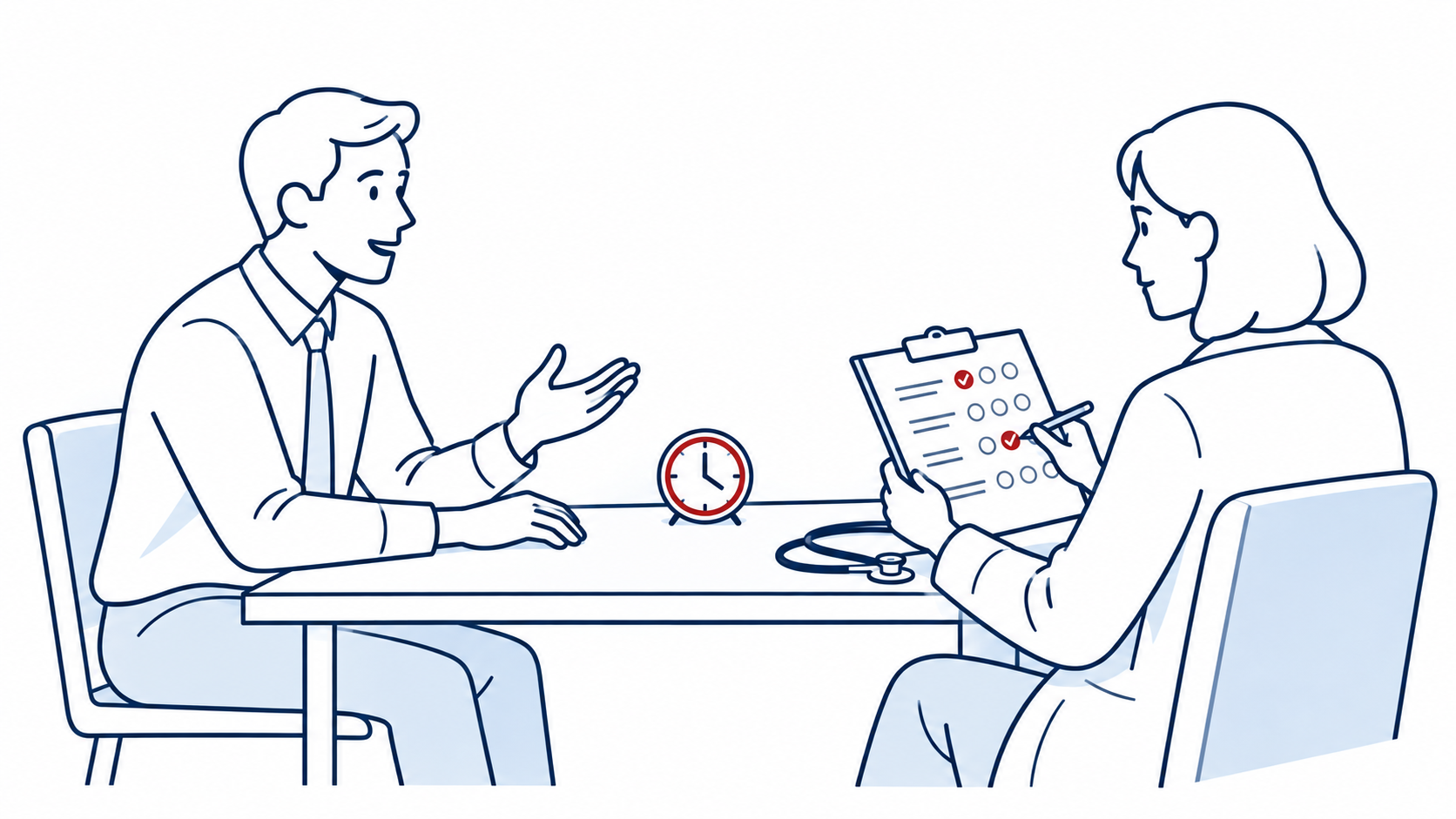
Summary: Most schools running the Multiple Mini Interview, or MMI, put you through 6 to 10 short stations, each with a different interviewer scoring you independently on one scenario. A rough answer at one station doesn’t sink the rest of your day, and that’s the entire point of the design. I scored applicants in this exact format at the Medical College of Georgia, and what actually moved a score was rarely the content of the answer. It was whether you could think out loud, adjust when you were wrong, and treat the person in front of you like a person instead of a test to pass. That ability to reason naturally without sounding rehearsed is also the foundation of the approach I teach in Inside the Medical School Interview. Below: how the scoring actually works station by station, what the AAMC’s own competency framework says you’re being graded on, where the published research on the MMI holds up and where it doesn’t, and what changes when your interview day looks like this instead of one long conversation.
What is the MMI, and why are so many schools using it?
The Multiple Mini Interview is an interview format built around several short, independent stations instead of one long sit-down. It was developed at McMaster University starting in 2001 and formally launched there in 2004, and it has since spread to medical, dental, pharmacy, and veterinary programs worldwide. McMaster built it to solve two specific problems: research kept showing traditional interviews didn’t predict how someone would actually perform once they were in training, and when licensing boards reviewed physicians after patient complaints, the complaints were almost never about medical knowledge. They were about interpersonal skills, professionalism, and judgment. The MMI was designed to test for those things directly, instead of hoping a single conversation would reveal them.
Here’s the thing that’s easy to miss: not every school runs an MMI, and the schools that do change their exact format from cycle to cycle. If you want to know what a specific school is doing this year, the AAMC’s Medical School Admission Requirements (MSAR) interview policies report is the actual source of truth, not a prep company’s list from two cycles ago.
How does MMI scoring actually work, station by station?
According to the AAMC, an MMI typically runs 6 to 10 stations, each with a different interviewer focused on a different question or scenario, and you get roughly five minutes at each one before rotating to the next station, though the exact timing varies by school. AAMC’s own applicant-facing guide describes the more common structure as a two-minute prep period followed by a conversation lasting five to eight minutes, with the whole circuit taking close to two hours.
The part that actually matters for you: each station is scored independently, usually by an interviewer who stays at that station the whole day while candidates rotate through. Your score at station three has nothing to do with your score at station one. This is deliberate. Research on interview scoring has documented something called the halo effect, where the impression an interviewer forms in the first few minutes tends to stick for the rest of the conversation, barely moving no matter what happens afterward. A single long interview is vulnerable to that. An MMI buffers against it, because a bad early read from one interviewer gets diluted across nine other independent reads instead of defining your entire application. That buffering effect, produced by multiple separate interviews rather than multiple interviewers sitting on one panel, is part of why the format was built the way it was.
What are interviewers actually grading you on?
Not knowledge. The MMI doesn’t test what you know, it tests how you think and how you carry yourself while you’re doing it. The AAMC groups the professional qualities medical schools are looking for into a set of competencies that were most recently updated for the 2024-25 cycle, with two of them renamed again in 2026. Here’s the current list of professional competencies, straight from the AAMC:
| Competency | What it actually looks like in a station |
|---|---|
| Commitment to Learning and Growth | You reflect honestly on a mistake or gap instead of defending it |
| Empathy and Compassion | You register the other person’s distress before jumping to a solution |
| Ethical Responsibility to Self and Others | You hold a position under pressure instead of caving to sound agreeable |
| Interpersonal Skills | You read the room and adjust your tone, not just your words |
| Oral Communication | You actually answer the question asked, not the one you rehearsed |
| Reliability and Dependability | You follow through on what the scenario asks of you, start to finish |
| Resilience and Adaptability | You recover when a station throws you off instead of visibly unraveling |
| Self-Awareness | You can say what you don’t know without it costing you the room |
| Service Orientation | Your instinct is toward the other person’s needs, not your own performance |
| Teamwork and Collaboration | You can share credit and take feedback inside a task-based station |
| Understanding Others | You engage with a perspective that isn’t yours without dismissing it |
Twelve of the AAMC’s other competencies fall under science and thinking-and-reasoning categories, but those get assessed through your coursework, MCAT, and application, not through an interviewer sitting across from you for five minutes. The interview exists specifically to test the professional column.
What happens if you bomb one station?
You keep going, and it usually matters less than it feels like in the moment. Because each station is scored independently and rotated across a full circuit, one flat answer, one nervous stumble, or one scenario you genuinely didn’t know how to approach gets averaged against everything else you do that day. Admissions committees using the MMI chose it partly because a single bad read from one interviewer isn’t supposed to define your entire evaluation. The mistake I’d actually worry about isn’t a rough answer. It’s carrying that rough answer into the next station on your face. An interviewer at station four has no idea what happened at station three, and if you walk in still rattled, you’re handing them information about your composure that has nothing to do with how you actually did.
Learning how to recover is something you can actually practice. The MMI section of Inside the Medical School Interview includes 60 practice stations so you can get used to thinking, answering, and resetting under the same kind of time pressure.
What do interviewers notice in the first thirty seconds?
Honestly, most of it isn’t the answer. It’s whether you walk in and treat the two-minute prompt like a real problem instead of a puzzle to be solved with a memorized structure. I scored applicants in the MMI format for medical school admissions, and the ones who stood out weren’t the ones with the most polished delivery. They were the ones who actually paused, thought for a second, and then talked like a person having a real conversation instead of performing a rehearsed one. The reality is, evaluators sit through the same scenario eight or ten times in a row. A canned opening line is not subtle. It’s the first thing that reads as a script, and once something reads as a script, everything after it gets heard through that filter.
Does the research actually back up the MMI?
Mostly, yes, with real caveats worth knowing. The initial McMaster pilot found high overall test reliability, reported at 0.81, and that reliability held up in a larger follow-up study on actual applicants, which is part of why the format spread the way it did. Follow-up research tracking those same candidates through medical school and into licensure exams found the MMI to be a stronger predictor of future clinical performance and professionalism than standard interview formats.
Here’s the part that doesn’t always make it into prep-company marketing: independent research has also found the MMI is not free of bias. A 2017 study out of the University of Calgary, published in Academic Medicine, found differences in how female and male applicants were rated. A separate 2015 study, also in Academic Medicine, examined how applicant race, ethnicity, and socioeconomic status related to MMI-based admissions outcomes at one medical school and found real associations. The format’s own creators have argued sex and underrepresented-minority status don’t meaningfully skew results, but that claim came from research tied to the people who built and commercialized the tool, which is a real conflict of interest worth naming rather than glossing over. The honest answer is that the MMI is a genuine improvement in reliability over a single unstructured interview, and it is still a human-scored process with the same limits every human-scored process has.
MMI vs. traditional and panel interviews: what actually changes?
| Format | Structure | Who scores you | How many chances you get |
|---|---|---|---|
| One-on-one | A single interviewer, usually 30-60 minutes | One person’s overall impression | One |
| Panel | Multiple interviewers in the same room at once | Several people, but on the same single conversation | One, viewed by several |
| Group | Multiple applicants together, one shared task | Interviewers watching the group dynamic | One, shared with others |
| MMI | 6-10 stations, roughly 5-8 minutes each | A different interviewer at each station, scoring independently | Multiple, aggregated |
The AAMC’s own guide to interview types lays out these same structural categories, and the practical difference for you is straightforward: a traditional or panel interview asks you to sustain one strong impression across a long conversation, while the MMI asks you to reset and perform well multiple separate times. Different skill, not necessarily a harder one.
How should you actually prepare for an MMI?
Don’t memorize answers. The MMI isn’t testing for a rehearsed response, it’s testing for how you reason through something you haven’t seen before, and a canned answer to a slightly different prompt than the one you prepared for is immediately obvious to whoever’s sitting across from you. Practice the actual mechanics instead: get comfortable using the two-minute prep window to jot down two or three points instead of trying to write a script, and get comfortable thinking out loud in a timed setting so the five-to-eight-minute window doesn’t feel like a countdown you’re racing against.
Practice with a range of station types, not just the ethics scenario everyone assumes is coming. AAMC’s applicant guide notes that in-person circuits can include a station involving an actor or standardized patient, a written station, a teamwork task done with another candidate, and sometimes a built-in rest station between the harder ones. Rehearsing only ethical dilemmas leaves you unprepared for a teamwork task that’s actually testing something closer to how you share credit and take direction.
And treat every station as its own event. If one goes badly, that’s information for you to process after the interview day is over, not something to carry into the next room. If you want to practice this instead of just reading about it, I built Inside the Medical School Interview around the same approach I used when evaluating applicants. It includes 60 MMI practice stations with guidance on how to approach them, plus 120 traditional interview questions, an interview-day cheat sheet, and the broader strategy I wish more applicants understood before walking into interview day.
[See Inside the Medical School Interview]
FAQ
Is the MMI harder than a traditional interview?
It’s different, not necessarily harder. A traditional interview rewards sustaining one strong impression over 30 to 60 minutes. An MMI rewards resetting and performing well multiple separate times, which favors people who recover quickly rather than people who build momentum slowly.
Can you actually fail one station and still get in?
Yes. Each station is scored independently and averaged across the circuit specifically so one weak answer doesn’t define your entire evaluation. That’s the reason schools adopted the format in the first place.
Do all medical schools use the MMI?
No. Some use it exclusively, some use a hybrid of MMI and traditional formats, and some don’t use it at all. The mix changes by cycle, so check the AAMC’s MSAR interview policies report for your specific target schools rather than relying on a prep company’s list.
Is the MMI biased against certain applicants?
The published research is mixed. Reliability and predictive validity are genuinely strong compared to unstructured interviews, but independent studies have found real differences by gender and by race, ethnicity, and socioeconomic status. It’s a better tool than a single unstructured conversation, not a perfect one.
How do I prepare if I don’t know exactly what stations I’ll face?
Prepare for the range of station types documented by the AAMC (ethical scenarios, role-play with an actor, written stations, teamwork tasks) rather than trying to guess your specific school’s exact questions. The skill being tested is how you reason under a time limit, not whether you predicted the prompt correctly.
4. Sources and Claims
| Claim | Source |
|---|---|
| MMI structure: 6-10 stations, ~5 min each, different interviewer per station | AAMC, Types of Interviews |
| Two-minute prep + 5-8 minute conversation, ~2 hour total circuit | AAMC, What It’s Like to Participate in Multiple Mini Interviews |
| MMI developed at McMaster starting 2001, formal launch 2004 | AAMC, What It’s Like to Participate in MMIs; Wikipedia, Multiple mini-interview |
| Rationale for MMI: traditional interviews don’t predict performance well; licensing complaints trace to interpersonal/professionalism/ethics issues, not knowledge gaps | Wikipedia, Multiple mini-interview, summarizing Eva KW, Reiter HI, Rosenfeld J, Norman GR, “An admissions OSCE: the multiple mini-interview,” Medical Education 38:314-326 (2004) |
| Initial pilot reliability of 0.81; MMI reliability markedly higher than other interview formats; halo effect explanation | Wikipedia, Multiple mini-interview, citing the Eva et al. 2004 studies |
| MMI predicts future clinical performance, professionalism, and licensure exam performance better than standard interviews | Reiter HI, Eva KW, Rosenfeld J, Norman GR, “Multiple Mini-Interview Predicts for Clinical Clerkship Performance, National Licensure Examination Performance,” Medical Education41(4):378-84 (2007), PMID 17430283 |
| Gender-based rating differences found in MMI scoring | Ross M et al., “Are Female Applicants Rated Higher Than Males on the Multiple Mini-Interview?” Academic Medicine 92(6):841-846 (2017), PMID 28557950 |
| Race, ethnicity, and socioeconomic status associated with MMI-based outcomes at one school | Jerant A et al., “How Medical School Applicant Race, Ethnicity, and Socioeconomic Status Relate to Multiple Mini-Interview-Based Admissions Outcomes,” Academic Medicine 90(12):1667-1674 (2015), PMID 26017355 |
| AAMC’s 17 premed competencies, 11 of them professional; 2026 renaming of “cultural humility” to “self-awareness” and “cultural awareness” to “understanding others” | AAMC, The Premed Competencies for Entering Medical Students |
| Interview format categories: one-on-one, group, panel, MMI | AAMC, Types of Interviews |
| In-person MMI circuits may include actor/standardized-patient stations, written stations, teamwork tasks, rest stations | AAMC, What It’s Like to Participate in MMIs |
Ready to Prepare for Your Medical School Interview?
Getting the interview means your application already did its job. Now you have to show the admissions committee that you’re someone they actually want in their class.
I created Inside the Medical School Interview to help you do exactly that. It combines what I learned as a medical school MMI interviewer with the strategies I wish applicants understood before interview day.
Inside, you’ll get:
- 60 MMI practice stations with guidance on how to approach each one
- 120 traditional interview questions and what interviewers are actually looking for
- A practical framework for answering difficult questions without sounding scripted
- An interview-day cheat sheet for the final review before you walk in
- My perspective from having been on the other side of the admissions process
You don’t need to memorize perfect answers. You need to understand what interviewers are evaluating and learn how to show them who you are under pressure.
Get Inside the Medical School Interview

Wil Caruso, MD is the founder of Pre-Med Community and a pre-med admissions consultant who knows the journey firsthand. After navigating the pre-med and medical school application process himself, he went on to serve as a medical school MMI interviewer and residency admissions committee member. He created Pre-Med Community to give aspiring physicians the honest, practical guidance he wishes every pre-med had access to.