
Understanding the Pre-Med Timeline
Summary
A traditional premed timeline usually begins with academic adjustment and exploration during freshman year, builds toward consistent clinical and service involvement during sophomore year, shifts to MCAT and application preparation during junior year, and ends with interviews, decisions, and matriculation during senior year. The exact order can change if you take a gap year, change majors, transfer schools, or discover medicine later. What matters is reaching each major checkpoint when you are genuinely ready, not forcing yourself through someone else’s calendar.
If you would like to use our personalized pre-med planner, click here.
The simple pre-med overview
Protect your GPA from the beginning. Add experiences gradually. Complete the courses you need for the MCAT and the schools on your list. Build sustained clinical exposure and service. Prepare for the MCAT without sacrificing your classes. Apply when your academic record, experiences, letters, and personal story are ready.

If you want a version built around your intended medical school start year, use the free personalized premed timeline planner. It works backward from your target matriculation year and creates a printable planner you can revisit each semester. You can also use the free medical school calculator to identify the parts of your current application that may deserve the most attention.
Why understanding the premed timeline matters
Premed students are expected to manage several long projects at the same time. You are completing difficult science courses, protecting your GPA, learning how to study, finding clinical experience, serving your community, considering research, preparing for the Medical College Admission Test, building relationships with letter writers, and eventually writing an application that explains why all of it matters.
Being a premed is hard. A lot of the stress comes from never feeling sure that you are doing the right thing at the right time.
I remember that feeling. I was a first generation, nontraditional premed, and I did not begin college with an inherited playbook for getting into medical school. My school did not have a premed adviser at the time, so I had to piece together much of the process myself. I worried about when to start extracurriculars, sometimes took courses in an awkward order, and occasionally put too many demanding classes into the same semester. Later, I mistimed my MCAT preparation and needed to take a gap year. I also waited too long to ask for recommendation letters, which created unnecessary stress during a period when I was already worried about the MCAT and my application.
None of those mistakes meant that I was incapable of becoming a physician. They meant I was trying to navigate a complicated process without a clear map. I eventually earned my MD from the Medical College of Georgia, interviewed and scored applicants in the Multiple Mini Interview format, and now help premed students make these decisions through consulting. The biggest difference between students who feel constantly behind and students who feel more in control is often not talent. It is understanding what matters now, what can wait, and how today’s choices affect the next stage.
Medical schools are not looking for a student who completed the most activities as quickly as possible. They are looking for evidence that you can handle demanding academics, understand the profession you are entering, serve and communicate with other people, grow from experience, and make thoughtful decisions. Your timeline should help you develop that evidence over time. It should not turn college into a four year panic.
That map also needs to be flexible. The Association of American Medical Colleges explains that every medical school sets its own prerequisite and recommendation policies (https://students-residents.aamc.org/medical-school-admission-requirements/admission-requirements). Schools differ on coursework, laboratory requirements, Advanced Placement credit, online classes, and community college courses. Your college, major, finances, health, and responsibilities will affect your plan too.
Use this article as a broad four year premed plan, then confirm the details for the schools you may apply to. The PMC medical school database can help you compare programs as it expands, and the AAMC’s official Medical School Admission Requirements resources remain the final authority for school specific policies.
What is the traditional premed timeline?
The traditional premed timeline is a four year college plan in which a student applies to medical school near the end of junior year and begins medical school after graduating from college. In that model:

This is a planning model, not a rule. A gap year is common and can be strategically useful. A student who needs more time for academic improvement, the MCAT, clinical exposure, finances, or personal responsibilities should not treat a gap year as failure. Applying before you are ready can cost more time, money, and emotional energy than waiting one intentional year.
The most useful way to read the timeline is by purpose rather than age. A freshman needs a foundation, whether that student is 18 or returning to college at 28. An applicant needs a credible academic record, meaningful experiences, a prepared MCAT attempt, supportive letters, and enough reflection to explain why medicine fits. If you are a transfer student, career changer, student athlete, caregiver, or someone who discovered medicine late, keep the sequence and adjust the calendar.
Freshman year premed timeline: adjustment and foundation

Freshman year is about learning how to succeed in college. Your first priority is not collecting every possible activity. It is building an academic system that can carry you through harder science courses later.
Recommended freshman premed coursework
A common starting schedule includes:
• General Biology I and II with laboratories
• General Chemistry I and II with laboratories
• One mathematics or statistics course, depending on your placement and major
• Writing, English, or humanities coursework
• General education courses required by your college
You do not need to take biology and chemistry together if the combination is likely to overwhelm you. The right course load is the most challenging schedule you can handle well, not the largest number of science courses you can fit into one semester.
Before registering, map prerequisites across all four years. Write down which courses require earlier courses, which are offered only once per year, and which you hope to complete before the MCAT. Then place your major requirements and general education courses around that sequence. This simple exercise can prevent a missed prerequisite from delaying biochemistry, physics, or graduation.
I wish I had done this more carefully. Without a premed adviser, I sometimes chose courses based on what fit the immediate semester instead of looking two or three semesters ahead. At other times, I placed too many hard courses together because I thought a serious premed was supposed to tolerate an extreme schedule. That approach created stress without making me a stronger applicant. A demanding schedule can demonstrate readiness, but only if you can learn the material and perform well.
Medical schools do not require a particular college major. Choose a field you can perform well in and genuinely care about, then complete the prerequisite courses required by the programs on your list. A science major may create overlap with premed requirements, but it is not automatically more impressive.
Freshman academic goals
Your freshman academic goals should be simple:
• Learn how you study best before your courses become harder
• Attend office hours early enough to build real faculty relationships
• Use tutoring, supplemental instruction, and academic support before a crisis
• Track both your cumulative GPA and your science GPA
• Avoid stacking difficult laboratory sciences merely to prove that you can
An early low grade does not automatically end your medical school path. A pattern of weak performance without adjustment is more concerning. If a class starts going badly, respond quickly. Change how you study, ask for help, reduce unnecessary commitments, and understand your school’s withdrawal and repeat policies before making a decision.
College science courses often require a different study method than high school. Rereading notes can feel productive while giving you little practice retrieving or applying information. Use practice questions, active recall, spaced review, and office hours to find out what you do not understand. Review each exam after it is returned. The goal is not only to see which questions you missed, but to identify whether the problem was content knowledge, application, timing, careless errors, or the way you prepared.
One common freshman pitfall is waiting until a course becomes an emergency before using support. Tutoring and office hours are not evidence that you do not belong. They are tools. Another pitfall is comparing your schedule with a classmate whose preparation, work obligations, or strengths are different from yours. Your schedule has to be sustainable for you.
Freshman extracurricular goals
Start small. One service commitment or a light introduction to clinical exposure is enough while you adjust to college.
Good freshman options include:
• Volunteering with a cause you would still value if it had nothing to do with medicine
• Shadowing a physician for a limited period to understand the work
• Joining one campus group where you can contribute consistently
• Exploring a hospital, hospice, clinic, emergency medical service, or community health role
The goal is exploration. You do not need research, leadership, shadowing, clinical employment, and three clubs during your first semester. If you want ideas, start with the premed extracurricular opportunities hub or review clinical and shadowing options for premed students
When choosing an activity, ask three questions. Can I show up consistently? Does the work matter to me or the people being served? Will I learn something about patients, service, teamwork, or myself? An activity does not need to answer all three questions, but it should have a clearer purpose than filling a line on an application.
I used to worry that there was a perfect semester for starting every activity and that beginning too late would permanently put me behind. There is no universal date. Starting one sustainable commitment and staying long enough to become useful is usually better than joining several activities because other premeds appear busier. Give yourself time to adjust, then add responsibility when your academic routine can support it.
Freshman summer
Use the summer to continue one activity, work, take a carefully chosen course, shadow, or explore a clinical role. You do not need an elaborate medical program for the summer to be productive. A regular job can demonstrate responsibility, communication, teamwork, and reliability. Those qualities matter too.
Choose the summer based on the problem you actually need to solve. If your finances require employment, work. If you need to confirm that you are comfortable in patient facing environments, seek clinical exposure. If a prerequisite would make the next year more manageable, consider the course after checking how potential medical schools treat summer or community college credit. Avoid using the summer to create another overloaded semester merely because you are afraid that rest looks unproductive.
Sophomore year premed timeline: consistency and exploration

Sophomore year is when your premed path should begin to look consistent. You understand college better, and you can start building depth without turning your schedule into a collection of unrelated activities.
Recommended sophomore premed coursework
A common sophomore schedule includes:
• Organic Chemistry I and II with laboratories
• Additional biology coursework
• Statistics, psychology, or sociology
• Writing intensive coursework
• Major and general education requirements
Some students take physics during sophomore year. Others take it during junior year. Biochemistry may be taken late in sophomore year or during junior year. The best sequence depends on your college, major, course availability, and intended MCAT date.
Psychology and sociology can support MCAT preparation, while statistics strengthens the quantitative reasoning used in research and evidence based medicine. Writing courses are also valuable because the application process demands clear reflection, concise descriptions, and a convincing personal statement.
Do not choose the sequence only by copying a sample schedule. Check the prerequisites at your college. Some biochemistry courses require organic chemistry, some physics sequences require calculus, and some majors reserve courses for particular students. Also look ahead to when you expect to take the MCAT. If the exam is planned for junior spring, taking a major tested subject for the first time during that same spring can make preparation harder.
A practical way to balance a semester is to identify the courses that will require the most problem solving, laboratory time, and memorization. Then add courses with different demands rather than stacking every heavy course together. There will be difficult semesters, but difficulty should be intentional. If you are working substantial hours, commuting, caregiving, or managing health concerns, include those obligations when judging what is realistic.
Sophomore academic goals
By the end of sophomore year, you want evidence that your academic performance is stable. If freshman year was difficult, sophomore year is your opportunity to show adjustment and improvement.
Focus on:
• Maintaining or improving your GPA trend
• Completing prerequisites without creating unnecessary overload
• Building relationships with professors who know how you think and work
• Reviewing the course requirements of schools you may eventually consider
• Becoming aware of the MCAT without beginning intense preparation too early
Sophomore year is also the time to look for patterns. Are your exam scores improving? Are you repeatedly losing points because you start studying too late? Are laboratory reports consuming far more time than you planned? Do you avoid asking professors questions because you are worried about appearing unprepared? Fixing these patterns now is more valuable than waiting for junior year, when the MCAT and application add more pressure.
Start keeping a simple planning document. List completed prerequisites, future courses, meaningful activities, dates, approximate hours, supervisors, and short notes about moments that affected you. This is not application writing. It is a memory system. Two years later, it will be much easier to write honestly about an experience if you recorded what happened while the details were fresh.
Sophomore extracurricular goals
This is a good time to establish one consistent clinical role and one meaningful service commitment. Depth is usually more valuable than activity hopping.
The AAMC describes several ways to gain experience in medicine, including volunteering, physician shadowing, laboratory work, and structured summer programs. Clinical experience should help you understand patients, health care settings, and the realities of service. Shadowing is useful for observing a physician’s work, but it is observational and should not be the only way you explore medicine.
Possible sophomore goals include:
• Begin a sustainable clinical position or volunteer role
• Continue one community service commitment
• Shadow physicians in one or more settings
• Explore research if you are genuinely interested
• Take on informal responsibility within an activity you already value
If research interests you, use the premed research opportunities guide to learn where to look and how to approach potential mentors. Research can strengthen an application and help you understand how medical knowledge develops, but it is not a universal requirement at every medical school.
Do not assume that every clinical role is equally useful or that a job title proves patient contact. Ask what you will actually do. A role that lets you communicate with patients, observe a health care team, and understand the realities of care may teach you more than a prestigious title with little involvement. Shadowing serves a different purpose. It helps you observe a physician’s responsibilities and workflow, but because it is passive, it usually should complement rather than replace active clinical exposure.
For service, look beyond activities that appear obviously medical. Food access programs, tutoring, crisis support, disability services, shelters, and community organizations can teach you how to listen, work with people whose lives differ from yours, and keep a commitment when the work is not glamorous. Those lessons matter in medicine. Choose a population or cause you respect, not an activity you think will sound impressive.
The most common sophomore mistake is activity hopping. Students become anxious about research, leadership, shadowing, and clinical hours, then add a new role every few weeks. They remain beginners everywhere and never stay long enough to contribute. A better goal is to establish one or two anchor commitments, then add something new only when you can explain why it belongs in your development.
Sophomore summer
Sophomore summer can be an excellent time for deeper involvement. You might work more hours in a clinical role, join a research project, continue service, take one prerequisite, or begin light MCAT familiarization.
Light familiarization means understanding the exam, reviewing the content categories, and taking stock of the prerequisite material you have completed. It does not mean forcing a full study schedule before you have the academic foundation or time to sustain it.
If you use the summer for research or clinical work, ask what good performance looks like and request feedback. Reliability often creates later opportunities for greater responsibility and stronger letters. If you study for the MCAT at all, focus on learning the structure of the exam, identifying content gaps, and deciding when a serious study block could realistically fit. A few scattered hours of low quality preparation over many months can create fatigue without creating readiness.
Junior fall premed timeline: build the MCAT and application foundation
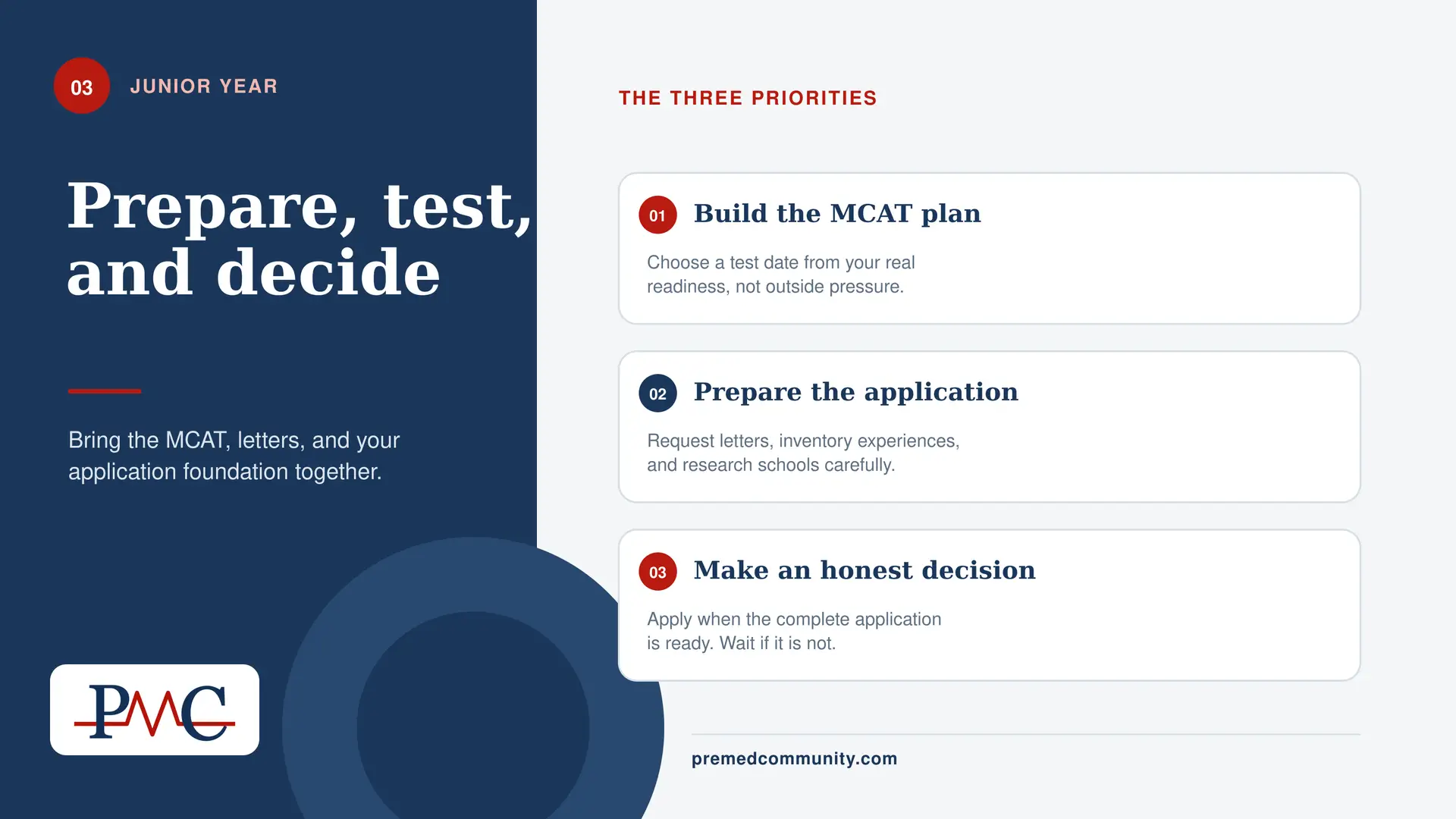
Junior year is where several long projects begin to converge. The main mistake is treating the MCAT, coursework, letters, activities, and application as separate problems until all of them become urgent at once.
Junior fall should be organized around preparation, not frantic application writing.
Recommended junior fall coursework
Depending on your earlier sequence, junior fall may include:
• Physics with laboratory
• Biochemistry
• Remaining biology or chemistry prerequisites
• Upper level science courses that fit your interests and preparation
• Major requirements
Ideally, you should complete the core subjects tested on the MCAT before or during your preparation period. The exam draws from biology, biochemistry, general chemistry, organic chemistry, physics, psychology, and sociology, along with critical analysis and reasoning.
Junior fall academic and MCAT goals
By the end of junior fall, aim to:
• Take a diagnostic MCAT if you have not already done so
• Choose a realistic test window
• Build a study plan around your actual course load and obligations
• Review whether your science foundation is strong enough to begin serious preparation
• Continue performing well in your classes
Do not let MCAT preparation destroy the GPA you have spent two years building. If the schedule is unrealistic, change the schedule. You can find focused guidance in the PMC MCAT article library .
Build the plan from evidence, not hope. A diagnostic score is useful because it shows your starting point, but it is not a prediction of your final score. Use it to identify content gaps and estimate the size of the project. Then calculate how many realistic study hours are available after class, work, sleep, commuting, and your core commitments. If the math does not work, the solution is not to pretend you will suddenly have more hours. Reduce obligations, move the test, or reconsider the application year.
I learned this lesson the hard way. I did not time my MCAT preparation well, and I ultimately needed a gap year. At the time, that felt like evidence that my plan had gone wrong. In reality, the gap year gave me time to correct the plan and apply with more readiness. I would rather see a student adjust early than hold onto a test date because changing it feels embarrassing.
Junior fall application and extracurricular goals
By October or November, identify potential letter writers and strengthen those relationships. By December, create a working inventory of every meaningful experience, including dates, roles, approximate hours, supervisors, responsibilities, and what you learned.
Continue your strongest clinical, service, and research commitments. This is not the semester to abandon meaningful work merely because the application is approaching.
Your junior fall checklist should include:
• Identify potential faculty and supervisor letter writers
• Keep an organized experience inventory
• Reflect on why medicine fits your values and experiences
• Identify gaps in clinical exposure, service, or academic preparation
• Begin broad medical school research
Reflection is useful now. Write down specific encounters, challenges, responsibilities, and changes in your thinking. Ask what each experience taught you about patients, teamwork, service, uncertainty, or the work of a physician. Heavy personal statement drafting can wait until your MCAT plan is stable, but waiting to reflect until the application opens often produces vague writing because the most important details have been forgotten.
Letter planning deserves more attention than many students give it. Make a list of the letter types that your likely schools request, then identify people who can speak to your work with specific examples. An impressive title cannot replace a genuine relationship. Attend office hours, contribute thoughtfully, and let potential writers see how you respond to feedback and difficulty.
I waited too late to ask for letters. That turned a manageable task into another source of pressure while I was already worried about MCAT timing. You can avoid that by identifying writers during junior fall, learning what materials they will need, and making formal requests with adequate notice in the spring. Do not wait until the week an application opens to discover that a professor is unavailable or does not remember you well.
Junior fall is also a good time to conduct a gap analysis without panicking. If you have little clinical exposure, the answer is not to collect a huge number of rushed hours. Find a sustainable role and reconsider whether the traditional application date still makes sense. If your grades are unstable, focus on the academic issue before adding more obligations. The point of the review is to make better decisions, not to punish yourself for an imperfect timeline.
Junior spring premed timeline: MCAT preparation and readiness assessment
Junior spring is often the most demanding part of the traditional premed timeline. You may be taking difficult classes, preparing for the MCAT, requesting letters, and deciding whether you are ready to apply.
January through March
During the first part of junior spring:
• Move into structured MCAT preparation
• Complete your experience inventory
• Identify any important application gaps
• Continue regular clinical and service involvement
• Strengthen relationships with letter writers
• Research application systems and school requirements
Ask yourself an honest question: if the application opened tomorrow, would the record you have already built support the story you want to tell?
You do not need perfection. You do need enough evidence. A strong application should show academic readiness, informed motivation for medicine, sustained engagement with patients or clinical settings, service, maturity, and the competencies medical schools expect from entering students.
Readiness is not one number. A strong GPA cannot fully compensate for having almost no understanding of clinical medicine. Hundreds of activity hours cannot erase an MCAT attempt taken before you were prepared. A polished personal statement cannot create relationships with letter writers that were never built. Review the application as a whole and ask what an unfamiliar reader would be able to conclude from the evidence you have.
Keep your spring commitments steady where possible. You do not need to maintain every activity at its highest intensity while studying for the MCAT, but disappearing from all service and clinical work can make the semester feel disconnected from the reason you are pursuing medicine. A reduced, predictable schedule is often better than alternating between overcommitment and complete withdrawal.
April through May
In late spring:
• Confirm your letter writers and ask whether they can write a strong letter
• Provide each writer with the information they need
• Complete full length MCAT practice under realistic conditions
• Decide whether your score trajectory supports your planned test date
• Begin outlining your personal statement if MCAT preparation is on track
• Build an initial school list using verified requirements and mission fit
The AAMC reports that official MCAT scores are generally released 30 to 35 days after the exam (https://students-residents.aamc.org/mcat-scores/mcat-scores). If you want a score available near the beginning of the application cycle, work backward from that release delay. A spring test date is common for traditional applicants, but the correct date is the one you are prepared to take.
If your practice results, academic record, experiences, or personal circumstances show that you are not ready, consider delaying the application. Applying early with an application that is not ready is not better than applying in a later cycle with one that is.
Use full length practice exams to test more than content knowledge. They also reveal whether you can maintain attention, pace yourself, eat and rest appropriately during breaks, and make decisions under fatigue. Review these exams carefully. The score matters, but the pattern of missed questions tells you what to change. If your results remain far from your goal near the test date, reassessing the date is a strategic decision, not a character judgment.
When requesting letters, ask whether the writer feels comfortable writing a strong recommendation. Provide a concise packet with your resume, relevant experiences, the course or work you completed with that person, your goals, and clear instructions. Give a reasonable deadline that is earlier than the date you truly need the letter, then send polite reminders. Requirements vary by school, so confirm whether programs prefer a committee letter, individual faculty letters, or particular categories of writers.
Begin the personal statement with reflection rather than a dramatic opening sentence. Identify the experiences that changed or clarified your understanding of medicine. Look for a thread that connects what you observed, what you did, and why you are choosing the responsibilities of a physician. Your first draft can be messy. The goal is to discover the honest argument before polishing the language.
Summer after junior year: primary application and secondaries
For a traditional applicant, the summer after junior year is usually the submission phase.
The American Medical College Application Service (https://students-residents.aamc.org/applying-medical-school-amcas/apply-medical-school-amcas-program), commonly called AMCAS, typically opens in early May, begins accepting submissions later in May, and sends the first verified applications to medical schools in late June. Exact dates change each cycle. AACOMAS (https://www.aacom.org/become-a-doctor/apply-to-medical-school), the application service used by participating osteopathic medical schools, follows its own calendar and generally opens in early May. Texas applicants using TMDSAS must follow that system’s separate dates and policies.
Always verify the current cycle calendar before planning around a specific date.
What to complete before submission
Your primary application may require substantial work on:
• Coursework entry and transcripts
• Personal statement
• Work and activities descriptions
• Most meaningful experiences
• Letters of evaluation
• School selection
• Disadvantaged or contextual information when applicable
Submitting in the opening days is not worth sending careless writing or an inaccurate application. At the same time, many medical schools use rolling admissions, so avoidable delay can become a poor strategy. The clean goal is to prepare early enough that you can submit a complete, carefully reviewed application near the beginning of the cycle.
Coursework entry deserves slow, careful attention because application services use your transcript information to calculate standardized GPAs. Order official transcripts according to the current instructions, enter courses exactly as required, and leave time to resolve discrepancies. Do not assume that your college’s GPA treatment, including how it handles repeated courses, will be identical to the application service calculation.
Build your school list after considering academic fit, mission, geography, cost, residency preferences, prerequisite policies, and the populations or training environments that matter to you. Do not apply to a school merely because it appears on a ranking or because its median numbers look attainable. You need a list of schools you would actually attend and for which you have a plausible fit. Use official school websites and current admissions resources to verify details.
If you want a broader readiness check, use the medical school calculator as a planning tool. It cannot predict an admissions decision, but it can help you think through your academics, MCAT, and experiences together.
Secondaries
Secondary applications often begin arriving after schools receive your primary application. Many schools ask overlapping questions about diversity of experience, adversity, service, fit, future goals, and why you are interested in that program.
Prewriting common themes can reduce the pressure, but each response still needs to answer the exact question and reflect the school. A practical target is to return a strong secondary within about two weeks of receipt when possible. Treat that as an organizational goal, not permission to submit weak writing quickly.
Create a simple tracker for the date each secondary arrives, the deadline, required essays, fees, and completion status. Group similar prompts, but do not paste a generic answer without adapting it. A good response shows that you understood the question and can connect your background or goals to the program without reciting the school’s website.
Secondary season is one reason the work done earlier matters. If you are still trying to remember activity details, locate letters, write the primary, and research every school after secondaries arrive, the workload becomes much harder than it needs to be. Preparation cannot remove all stress, but it can keep routine tasks from becoming emergencies.
Continue your clinical, service, research, employment, and academic responsibilities during the cycle. Medical schools may ask for updates, and sustained involvement matters more than disappearing once the application is submitted.
Senior year premed timeline: interviews, decisions, and finishing well
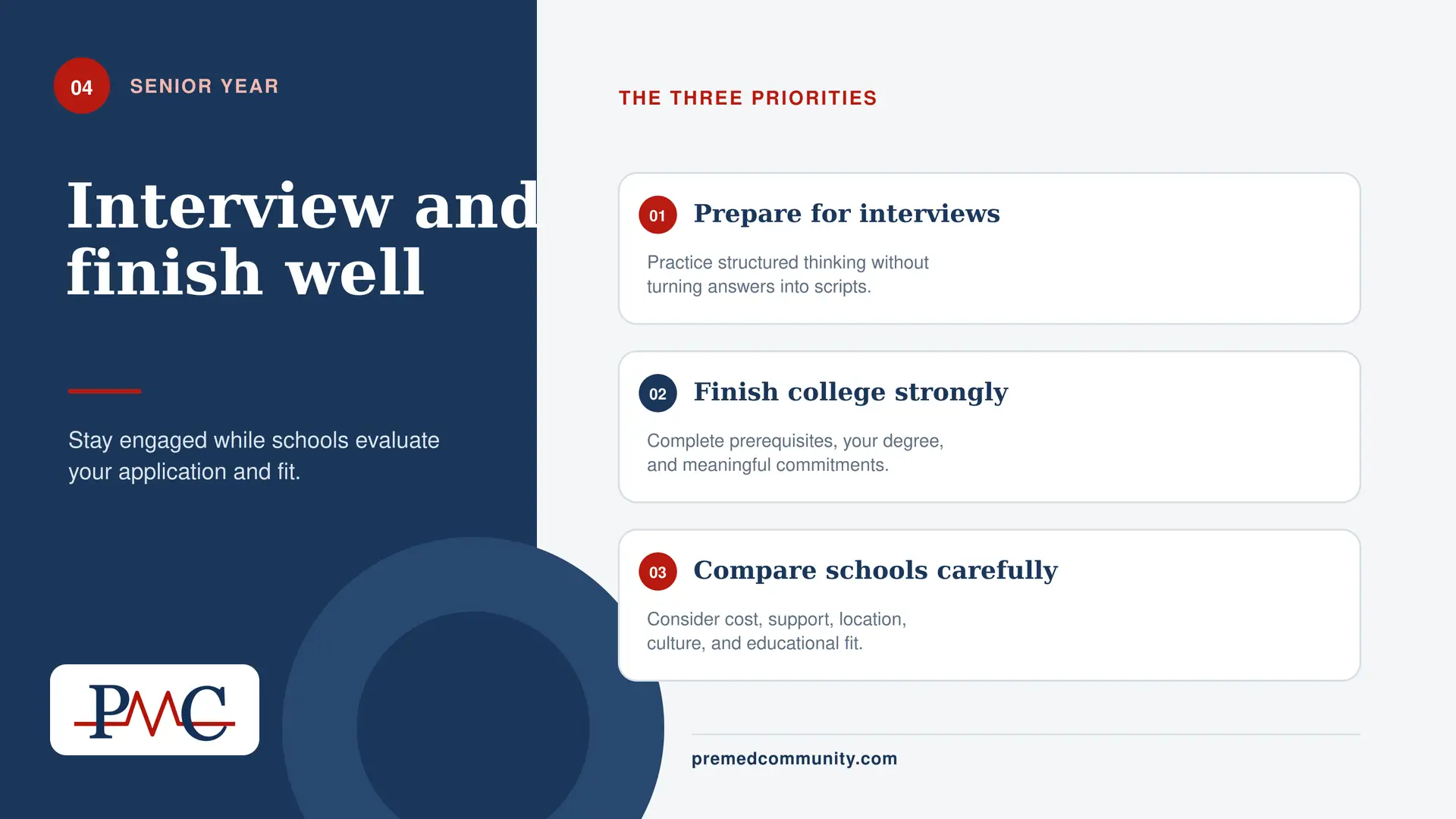
Senior year is a year of uncertainty for many applicants. Some students receive interviews early. Others wait for months. Your job is to remain engaged while responding professionally to each new step.
Senior fall priorities
During senior fall:
• Prepare for traditional, panel, virtual, or Multiple Mini Interviews as required
• Continue your most meaningful activities
• Complete remaining prerequisites and degree requirements
• Respond promptly to interview invitations and school communications
• Send updates only when a school permits them and you have something meaningful to add
• Prepare financially for interviews, deposits, relocation, and matriculation
Interview preparation should help you think clearly and communicate authentically. It should not turn every answer into a memorized script. I have been on the interviewer side of the MMI, and the difference between structured preparation and rehearsed performance is usually obvious.
Prepare by knowing your own application, practicing how you reason aloud, and reviewing common ethical, teamwork, health care, and personal questions. For an MMI, the evaluator is often more interested in how you identify competing considerations, communicate, and respond to new information than in hearing a perfect conclusion. Practice with feedback, then keep your language natural.
The waiting can be emotionally difficult. Set a reasonable routine for checking email and application portals, then continue living your life. Avoid interpreting every week without news as a final judgment. At the same time, remain reachable and follow each school’s instructions carefully. Missing a deadline because an invitation went to spam is preventable.
If you want deeper interview preparation, Inside the Medical School Interview explains the interview system, traditional interviews, and MMIs. PMC also offers mock interviews for students who want individualized practice and feedback.
Senior spring priorities
During senior spring:
• Finish your degree and prerequisites strongly
• Compare acceptances using fit, cost, support, location, and educational opportunities
• Follow each school’s acceptance, deposit, and enrollment instructions
• Complete financial aid requirements
• Make a backup plan if you remain on waitlists or do not receive an acceptance
• Keep your conduct and academic performance professional through graduation
If the cycle does not end in an acceptance, pause before immediately submitting the same application again. A reapplication should show meaningful improvement and a clear diagnosis of what limited the prior cycle.
That diagnosis may involve the school list, timing, MCAT, academics, clinical exposure, writing, letters, or interview performance. It may involve several areas at once. Seek candid feedback where available and decide what evidence would make the next application materially different. Simply accumulating another year of hours without addressing the real weakness is not a strategy.
After acceptance: prepare for medical school matriculation

Acceptance changes the task. You no longer need to keep adding accomplishments for the sake of the application. You need to complete the requirements your school gives you and prepare for a demanding transition.
Common priorities include:
• Final transcripts and proof of degree completion
• Immunization, health, background, and compliance requirements
• Financial aid, budgeting, and loan planning
• Housing and relocation
• Technology and equipment requirements
• Closing out work, research, and service commitments responsibly
• Taking genuine time to rest when possible
Do not spend the entire summer trying to teach yourself medical school. Your program will tell you what must be completed before orientation. A thoughtful reset, stable routines, and practical preparation are often more useful than attempting to prelearn the first semester.
Finish your existing commitments well. Give employers and volunteer organizations appropriate notice, transfer responsibilities, thank mentors, and preserve professional relationships. Then make room for ordinary life. Medical training is demanding, and rest before orientation is not wasted time.
PMC’s Medical School Survival Guide is planned as a future course for accepted students who want a clear framework for succeeding once medical school begins. You can check the PMC courses page for current availability.
Frequently Asked Questions (FAQ)
How should premed coursework fit into the timeline?
Premed coursework should do three things: satisfy school requirements, prepare you for the MCAT, and demonstrate that you can handle rigorous science.
Common courses across many medical schools include:
• Biology with laboratory
• General chemistry with laboratory
• Organic chemistry with laboratory
• Physics with laboratory
• Biochemistry
• Mathematics or statistics
• English or writing intensive coursework
• Psychology and sociology as useful MCAT preparation
This is a planning list, not a universal set of requirements. The AAMC notes that requirements vary by school, including whether programs accept Advanced Placement credit, online classes, or community college coursework.
A sensible sequence is often:
1. Begin biology and general chemistry during freshman year.
2. Continue into organic chemistry during sophomore year.
3. Complete physics, biochemistry, and remaining MCAT related coursework by junior year.
4. Use senior year for remaining prerequisites, major courses, and upper level work that supports your interests.
There are many valid variations. If sequencing two laboratory sciences together would meaningfully damage your performance, adjust the plan. Academic strength matters more than matching a generic chart exactly.
How to build your own course sequence
Start with the official degree audit and course catalog from your college. Mark every prerequisite chain and note which courses are offered only in fall or spring. Next, review the requirements of a reasonable sample of medical schools, including any public schools where your residency may matter. Finally, work backward from your possible MCAT date so that most tested content is completed before serious preparation.
Then stress test the plan. Count the laboratory hours, major assignments, commuting time, work shifts, athletics, caregiving, and activity commitments in each semester. A schedule that looks balanced by credit hours may be badly unbalanced by workload. Organic chemistry with lab, physics with lab, an intensive writing course, and a demanding job can be far more difficult than the number of credits suggests.
If your college does not have a strong prehealth advising office, you are not out of options. Use the registrar, individual department advisers, course instructors, official medical school admissions pages, and AAMC or AACOM resources. Keep your own spreadsheet of requirements and confirm information directly. That is more work, and I know how isolating it can feel because I had to make many of these choices without a premed adviser. Still, a careful self built plan is much safer than relying on a single anonymous list online.
Common coursework mistakes
One mistake is front loading difficult sciences to prove seriousness. Medical schools will see the grades, not the private reason you created an unnecessarily punishing semester. Another is postponing prerequisites without checking the downstream effect. Delaying general chemistry may delay organic chemistry, which may delay biochemistry and affect your MCAT plan.
Students also sometimes choose courses based only on what is easiest. Protecting your GPA matters, but avoiding every rigorous course can leave you underprepared. The goal is reasonable challenge with strong performance. If you experience an academic setback, respond with a concrete change in study method, workload, or support. An upward trend is meaningful because it shows that you identified a problem and improved.
When should you take the MCAT?
Take the MCAT when you have completed most of the tested prerequisite material, can sustain a serious study period, and are scoring near your goal under realistic practice conditions.
Traditional applicants often test during the spring of junior year so the score is available near the beginning of the summer application cycle. Because official scores are generally released 30 to 35 days after the exam, a later test date can delay the point at which you can make a score informed school list.
That does not mean every student should test by May. A later prepared attempt is better than an earlier unprepared one. If you are balancing difficult classes, work, caregiving, or a weak content foundation, your application timeline may need to change.
Work backward from the score release date
Your test date affects more than the day you sit for the exam. Official scores are generally released 30 to 35 days later. You also need time before the test for content review, question practice, full length exams, and careful review of mistakes. After the score arrives, you may want to adjust your school list. Put all of those steps on one calendar before registering.
A common error is choosing a date because it looks ideal for the application cycle and then trying to force preparation into the remaining time. Reverse the logic. Estimate the preparation you need, identify a study period you can protect, and select a date that follows that work. If the resulting date makes the current application cycle unwise, address that honestly.
That is close to the mistake I made. My MCAT timing did not match my actual readiness, and the timeline had to change. I needed a gap year. I did not enjoy realizing that, but taking the extra time was better than pretending the original plan was still sound. A gap year used to prepare well is a strategic adjustment. An unprepared MCAT attempt can create a problem that takes longer to repair.
Signs that you may need more time
Consider moving the exam or application timeline if:
• You have not completed important tested coursework and cannot independently learn the gaps
• Full length practice scores remain meaningfully below your realistic goal
• Review shows the same weaknesses without improvement
• Your study schedule depends on sacrificing sleep or current coursework
• Work, caregiving, health, or financial demands prevent a consistent preparation block
• You are keeping the date mainly because changing it feels like failure
Use practice results and your circumstances to make the decision. Anxiety alone does not mean you are unprepared, but optimism alone does not mean you are ready.
Use the PMC MCAT articles to build a study approach, and verify current test dates and score release dates on the official AAMC MCAT calendar.
What is the right extracurricular timeline for premed students?
The strongest extracurricular timeline usually progresses from exploration to consistency to responsibility.
Freshman year
Explore one or two areas without overwhelming yourself. A light service commitment, brief shadowing experience, campus organization, or introductory clinical role can help you understand what interests you. The goal is not to construct an impressive resume during your first semester. It is to learn how much time you can commit without damaging your academic transition and to begin testing whether the realities of medicine match your expectations.
Choose activities that you can attend consistently. If a role requires training, ask how long volunteers usually stay and what responsibilities you will eventually earn. Keep short notes about what you observed and what questions the experience raised. Avoid joining several organizations, attending each twice, and assuming that variety is the same as exploration. Meaningful exploration requires enough time to move beyond the first impression.
Sophomore year
Build consistency. By now, try to establish regular clinical exposure and a service commitment that matters to you. Clinical exposure helps you understand patients and health care delivery. Community service helps demonstrate that your commitment to other people is not limited to settings that benefit your application. These experiences can overlap, but they do not always need to.
This is also a reasonable time to explore research if you are curious about it or may apply to research focused schools. Contact investigators with a specific explanation of what interests you and be prepared to begin with basic tasks. Reliability matters. You do not need a publication for research to be worthwhile, but you should understand the question, your role, and what you learned about evidence and uncertainty.
The sophomore pitfall is reacting to comparison. Another student may already be an EMT, research assistant, club officer, and volunteer. That does not mean you need to copy the same combination. Ask whether your own commitments are becoming deeper and whether you are still performing well academically. Add one role for a reason, not four roles from fear.
Junior year
Continue your strongest commitments while protecting time for the MCAT and application. You may reduce hours temporarily, but avoid dropping every activity unless your circumstances require it. Sustained involvement helps you demonstrate growth and keeps you connected to the people and work that informed your decision to pursue medicine.
Seek responsibility naturally. That could mean training new volunteers, coordinating a shift, taking ownership of part of a research project, or becoming more effective in a patient facing role. Leadership is not limited to holding a title. It is often visible in how you solve problems, support a team, and accept responsibility.
Review your experience inventory before application season. Can you explain what you actually did, how you affected others, what challenged you, and how the experience influenced your understanding of medicine? If your description relies only on the organization’s mission or the number of hours, you may need deeper reflection. Junior year is late for random box checking, but it is not too late to address a genuine gap by changing the application timeline.
Senior year and gap years
Sustain meaningful work. Do not abandon your activities after submission as though their only purpose was admission. Schools may ask about updates, but the more important point is that patients, coworkers, research teams, and community organizations were relying on you before you applied.
If you are in a gap year, give the year a clear purpose. Full time clinical work can deepen your understanding of patient care. Research can develop analytical skills and lead to greater ownership. Service can show sustained commitment to a community. Academic work may be appropriate when you need to demonstrate readiness. The right choice depends on the weakness or uncertainty you are addressing.
A busy gap year is not automatically a productive one. Avoid collecting unrelated activities without a diagnosis of what your application needs. Set two or three concrete goals, maintain enough balance to avoid burnout, and keep reflecting on how the year is changing your preparation for medicine.
There is no official universal number of clinical, volunteer, shadowing, research, or leadership hours that guarantees admission. Schools evaluate experiences in context. Meaning, consistency, reflection, and evidence that you understand the profession are more useful than chasing an arbitrary number.
When evaluating an opportunity, look at access and sustainability too. Unpaid work is not morally superior to paid work. Many students need employment, and paid clinical roles can be valuable. Family responsibilities, transportation, disability, finances, and local availability shape what is possible. Your task is to use the opportunities available to you purposefully and explain your choices honestly.
Use these PMC hubs when you need concrete opportunities:
• Premed extracurricular opportunities
• Premed research opportunities
• Premed clinical opportunities, shadowing, and clinical work
How do clinical experience, shadowing, service, and research differ?
These experiences are related, but they are not interchangeable. Take a look at the below picture to understand how these experiences play a role into your application.
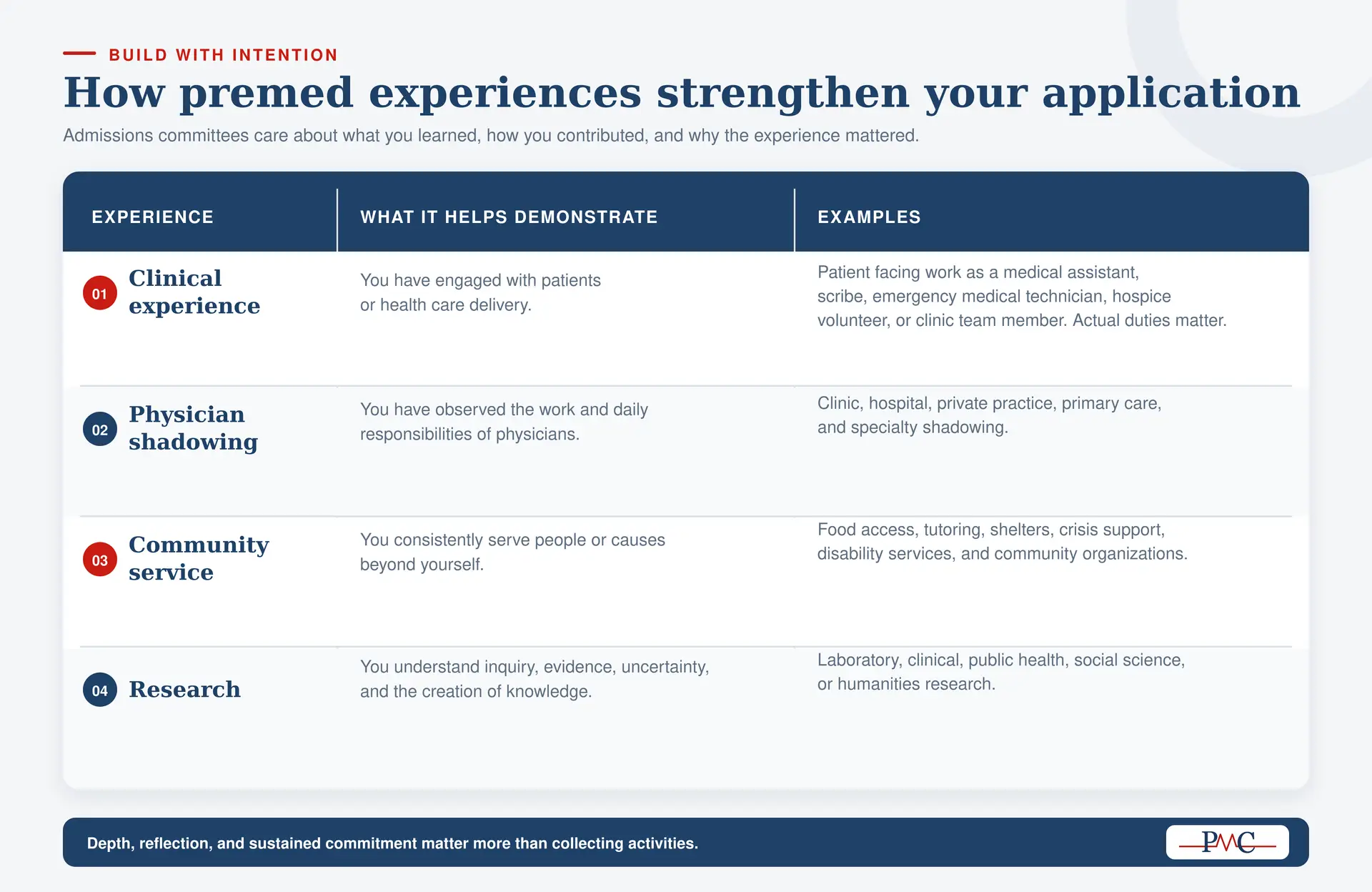
One experience may overlap categories, but do not force every activity to sound medical. Service should still be service. Research should still be research. A job can still matter even when it is not clinically related.
The larger question is whether your experiences help you understand medicine, other people, and your own reasons for choosing this path.
How to find opportunities without a built in network
Start locally. Search hospital volunteer offices, community clinics, hospice organizations, emergency medical services, physician practices, public health departments, food access programs, tutoring organizations, disability services, and university research directories. Ask professors, advisers, classmates, and current volunteers how they found their roles. For shadowing, begin with physicians you already know through your own care or community, then ask respectfully whether they or a colleague permits students to observe.
Expect some unanswered emails and unavailable programs. That is normal. Send concise, professional messages that explain who you are, why that specific opportunity interests you, what availability you have, and any relevant preparation. Keep a tracker so you can follow up once without repeatedly contacting the same person. If one type of opportunity is inaccessible in your area, choose another meaningful way to learn and serve rather than waiting indefinitely for a perfect position.
Before accepting a role, ask about training, duties, scheduling, supervision, and the expected commitment. A sustainable weekly shift over a long period often teaches more than an intense role you cannot maintain. If a position is called clinical but involves no patients or health care delivery, understand that before relying on it as your main clinical exposure.
How should the medical school application timeline influence your plan?
Work backward from the year you want to enter medical school.
For a traditional applicant planning to start medical school immediately after college:
• Complete most MCAT content courses by junior year
• Prepare for and take the MCAT by late junior year when ready
• Request letters during junior spring
• Prepare the primary application during spring
• Submit during the early part of the summer application cycle
• Complete secondaries during summer
• Interview during senior year
• Matriculate after graduation
For an applicant taking one gap year, shift the application process one year later. That extra year can be used for full time clinical work, research, service, academic improvement, MCAT preparation, or financial preparation. The year should have a clear purpose, not merely fill time.
Applying one year later usually means completing senior year before submitting, then interviewing during the gap year and matriculating the following fall. That schedule can remove the MCAT and primary application from an already crowded junior spring. It also allows your senior grades and additional experiences to appear in the initial application rather than only as updates.
The tradeoff is time, and that matters. A gap year can affect finances, employment, housing, and personal plans. Make the decision by comparing those real costs with the likely benefit of a stronger, less rushed application. Do not take a gap year merely because it is common, and do not avoid one merely because you believe the traditional timeline is more impressive.
If you are unsure whether to apply now or wait, individual premed consulting can be useful when generic advice is no longer enough. The goal is not to sell every student consulting. It is to help students with complicated timelines make a decision based on the full application.
How should letters of recommendation fit into the premed timeline?
Strong letters are built long before they are requested. During freshman and sophomore year, attend office hours, participate thoughtfully, seek feedback, and let instructors see how you learn. During junior fall, identify likely writers and review the letter policies of schools you may consider. During junior spring, make formal requests with enough notice for the writer to do thoughtful work.
Choose writers for what they can say, not only for their credentials. A professor who can describe your intellectual growth, persistence, teamwork, and performance with specific examples is usually more helpful than a prominent person who barely knows you. The same principle applies to research mentors, supervisors, and physicians. A shadowing letter may be less informative if the physician only watched you observe.
When you ask, use clear language: ask whether the person can write a strong recommendation. Give them an easy way to decline. If they hesitate, choose someone else rather than pressuring them into a vague letter. Provide your resume, a draft or summary of your goals, relevant work from the course or activity, the deadline, and submission instructions. Requirements differ across schools, so verify whether you need science faculty, nonscience faculty, a committee packet, or other specific letters.
My own mistake was waiting too long. I was already managing MCAT uncertainty, and the late requests turned letters into another urgent problem. The stress was avoidable. Identifying writers early does not mean asking a freshman professor to submit a letter years in advance. It means building genuine relationships and understanding the requirements before the deadline is close.
When should you write the personal statement and activities?
Reflection should begin early, but focused drafting usually belongs closer to the application. Keep an experience log throughout college with dates, responsibilities, meaningful moments, challenges, and what changed in your thinking. By junior fall, review that record for themes. Once your MCAT plan is stable, often in late junior spring for a traditional applicant, begin drafting the personal statement and activity descriptions in earnest.
The personal statement needs to answer why you are choosing medicine, using evidence from your life. It should not be a resume in paragraph form or an attempt to prove that you have every desirable trait. Specific scenes and decisions are useful when they reveal how your understanding developed. The reader should be able to see what you learned and why the physician’s role fits better than another helping profession.
Activity descriptions need the same honesty. Explain what you did, then use selected examples to show contribution, growth, or insight. Do not inflate your responsibility, turn every interaction into a life changing event, or force a medical lesson onto ordinary employment. Authentic work, family responsibility, and nonmedical service can belong in the application when they shaped you.
Plan for several revisions. Ask a small number of thoughtful readers for feedback on clarity, credibility, and whether the writing sounds like you. Too many reviewers can flatten your voice and produce contradictory advice. PMC offers personal statement and application support for students who want individualized feedback, but the final story and language should remain yours.
How do you know whether to apply now or take a gap year?
Consider the application as a complete file. A gap year may be useful if your MCAT preparation is not on track, your academic trend needs more evidence, your clinical exposure is too limited to support an informed decision, your letters are weak or unavailable, your writing is rushed, or your personal and financial circumstances make the cycle unrealistic.
Ask what would be different one year from now. A useful answer is specific: a completed postbaccalaureate sequence with strong grades, a prepared MCAT attempt, a year of patient facing work, deeper research responsibility, sustained service, or enough distance from a difficult period to apply thoughtfully. If the only answer is that you will be older, the year needs a clearer plan.
I needed a gap year after getting my MCAT timing wrong. It was not part of the plan I originally imagined, but it became part of the path that worked. That experience is one reason I do not treat a delayed application as a defeat. Medicine is already a long career. Starting one year later is often less consequential than entering an application cycle before you can present your best evidence.
There are situations where applying now makes sense even if every component is not perfect. No applicant is perfect. The question is whether the weaknesses are manageable within an otherwise credible application or whether they prevent the file from answering a central admissions question. If you cannot tell the difference, that is a reasonable time to seek a candid outside review.
Frequently asked questions about the premed timeline
What should a freshman premed do first?
Build a reliable study system, protect your GPA, map your prerequisite sequence, and explore one manageable service or clinical activity. Meet with a prehealth adviser if one is available, but keep your own record of requirements and verify school specific policies. Freshman year should create stability, not exhaustion.
What classes should premed students take freshman year?
Many students begin with general biology and general chemistry with laboratories, along with mathematics, writing, and general education courses. Your placement, major, and college sequence may change that plan. Confirm school specific requirements before treating any schedule as universal.
When should a premed student start clinical experience?
There is no single required starting date. Light exposure during freshman year is reasonable, while a consistent role by sophomore year gives you time to learn, contribute, and decide whether medicine fits you. If academics or personal responsibilities require a later start, choose a sustainable role when you can participate consistently instead of rushing through short experiences.
When should I start studying for the MCAT?
Begin serious MCAT preparation after you have completed most tested prerequisite content and can protect a dedicated study period. Many traditional applicants begin focused preparation during junior year. Earlier awareness is useful, but years of unfocused studying usually are not. Use a diagnostic to identify your starting point, then build a plan that includes content review, practice questions, full length exams, and review of mistakes.
When should I take the MCAT if I want to apply without a gap year?
Many traditional applicants test in the spring of junior year. Choose a date that allows enough preparation and remember that official scores are generally released 30 to 35 days after the test. Readiness matters more than copying another student’s date.
When should I ask for medical school recommendation letters?
Build faculty and supervisor relationships throughout college, identify likely writers during junior fall, and make formal requests during junior spring for a traditional application timeline. Ask whether the person can write a strong letter and give them enough time and context.
When should I start my medical school personal statement?
Begin reflection and experience tracking well before the application, then move into drafting once your MCAT plan is stable. For traditional applicants, late junior spring is a common time to begin focused drafting. Leave time for several meaningful revisions.
Do I need research to get into medical school?
Research is valuable and may be especially important at research intensive schools or for applicants interested in academic medicine. It is not a universal requirement at every medical school. Choose it because it fits your goals, not because you believe every applicant must check the same box.
How many clinical or volunteer hours do I need for medical school?
There is no official universal hour requirement that guarantees admission. You need enough sustained experience to understand the setting, contribute meaningfully, and explain what you learned. School expectations and applicant context vary.
Is taking a gap year bad for medical school?
No. A purposeful gap year can strengthen academics, MCAT preparation, clinical experience, research, service, finances, or personal readiness. Decide what the year is meant to accomplish and choose work or coursework that creates evidence of that improvement. A gap year becomes weak only when the time is unfocused and does not address what your application needs.
What if I decide to become premed late?
Build a new timeline from your current position rather than trying to catch up instantly. Map prerequisites, protect your GPA, begin meaningful exposure, and allow enough time for the MCAT and application. Nontraditional applicants often need a different sequence, not a rushed version of the traditional one.
When should I apply to medical school?
Apply when your academic record, MCAT, experiences, letters, and written application are ready to withstand review together. For traditional applicants, that is often the summer after junior year. If a major part of the application is still developing, waiting may be the stronger decision.
Your premed timeline should create clarity, not panic
You do not need to complete every part of the medical school application during freshman year. You need to build the foundation that lets the next stage go well.
Freshman year is for adjustment. Sophomore year is for consistency. Junior year is for readiness and execution. Senior year is for interviews, decisions, and finishing well. A gap year, when needed, is for intentional strengthening.
If you want to turn this guide into a plan you can actually use, create your free personalized premed timeline and printable planner. It works backward from the medical school start year you choose and gives you a practical map to revisit each semester. You can also use the medical school calculator to think through which parts of your application may deserve more attention.
The goal is not to make your path look identical to someone else’s. The goal is to understand what each stage is for, make honest decisions about readiness, and keep moving without losing sight of why you chose medicine in the first place.
If you want to keep learning one topic at a time, browse the free PMC premed articles. The clinical experience, research, MCAT, application, and interview guides can help you go deeper when each part of the timeline becomes relevant.
If you are overwhelmed or unsure what to do next, you are welcome to book a premed consulting call with me. We can look at your actual courses, experiences, MCAT timing, and application plans together so you leave with a clearer next step. And if you have not already, get the free Pre-Med Beginner Guide. It explains the road to medical school in plain language and is a useful companion to this more detailed timeline.
Official sources and further reading
• AAMC: Admission Requirements (https://students-residents.aamc.org/medical-school-admission-requirements/admission-requirements)
• AAMC: Premed Competencies for Entering Medical Students (https://students-residents.aamc.org/real-stories-demonstrating-premed-competencies/premed-competencies-entering-medical-students)
• AAMC: Required Premedical Coursework and Competencies (https://students-residents.aamc.org/medical-school-admission-requirements/required-premedical-coursework-and-competencies)
• AAMC: Get Experience in the Medical Field (https://students-residents.aamc.org/getting-experience/get-experience-medical-field)
• AAMC: Shadowing a Doctor (https://students-residents.aamc.org/aspiring-docs-fact-sheets-get-experience/shadowing-doctor)
• AAMC: Apply to Medical School with AMCAS (https://students-residents.aamc.org/applying-medical-school-amcas/apply-medical-school-amcas-program)
• AAMC: MCAT Scores (https://students-residents.aamc.org/mcat-scores/mcat-scores)
• AACOM: Apply to Medical School (https://www.aacom.org/become-a-doctor/apply-to-medical-school)
